 Ashutosh Nayak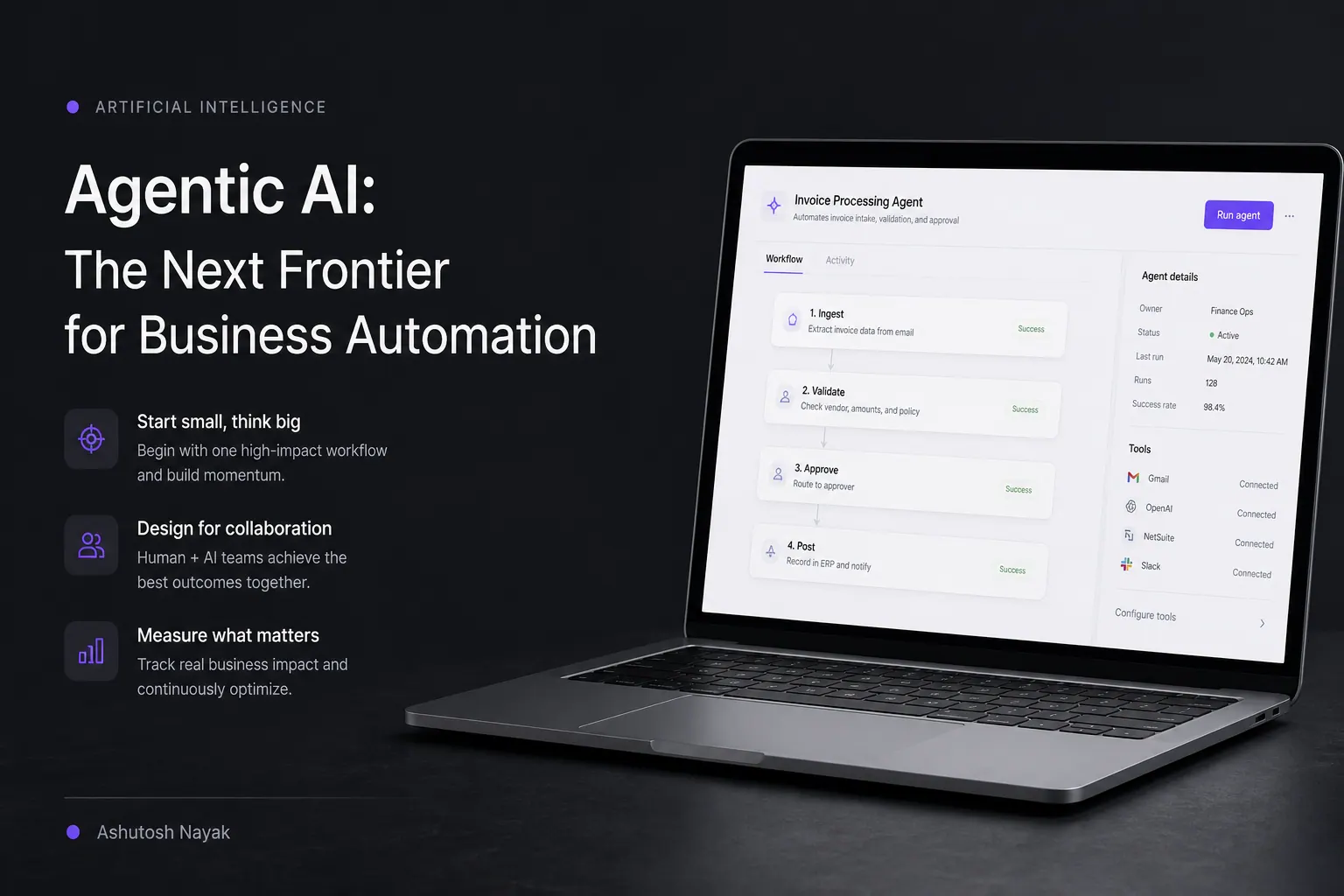
The Dawn of Autonomous Agents
Artificial Intelligence (AI) has been a buzzword for decades, promising to transform industries and reshape our daily lives. We've witnessed the rise of sophisticated machine learning models capable of image recognition, natural language processing, and predictive analytics. However, a new paradigm is emerging, one that promises to take AI from powerful tools to truly autonomous collaborators: Agentic AI.
At its core, agentic AI refers to systems that can perceive their environment, make decisions, and take actions independently to achieve specific goals. Unlike traditional AI models that perform discrete tasks, agents possess a degree of autonomy, agency, and proactivity. They are not just reactive; they can strategize, learn from experience, and adapt their behavior in complex, dynamic environments. This evolution marks a significant leap towards AI that can not only assist but also independently manage and execute business processes.
Deconstructing Agentic AI: Key Components
To understand the power of agentic AI, it's crucial to break down its fundamental components:
-
Perception: Agents must be able to gather information from their surroundings. This can range from reading data streams and analyzing sensor inputs to understanding user requests and interpreting documents.
-
Reasoning and Planning: Once information is perceived, agents need to process it, infer meaning, and formulate a plan to achieve their objectives. This involves sophisticated algorithms, often leveraging large language models (LLMs) for contextual understanding and complex decision-making.
-
Action: The ability to act upon the environment is what differentiates agents. This could involve making API calls, updating databases, sending communications, controlling robotic systems, or even initiating further AI processes.
-
Learning and Adaptation: True agents don't remain static. They learn from the outcomes of their actions, refining their strategies and improving their performance over time. This continuous learning loop is critical for navigating the complexities of real-world scenarios.
-
Memory: Agents often require a form of memory to retain context, track progress, and recall past experiences. This can range from short-term working memory for immediate tasks to long-term memory for building knowledge bases.
The Evolution from Traditional AI to Agentic AI
It's important to see agentic AI not as a replacement for existing AI technologies, but as an advanced application and integration of them. Consider these parallels:
-
Machine Learning (ML): ML models provide the intelligence that agents use for perception, prediction, and pattern recognition. An agent might use an ML model to classify customer sentiment, predict sales trends, or identify anomalies in a system.
-
Large Language Models (LLMs): LLMs are arguably the most significant enabler of modern agentic AI. Their ability to understand and generate human-like text, reason about complex information, and follow instructions makes them ideal for the reasoning and planning phases of an agent. LLMs can break down a high-level goal into a sequence of actionable steps, retrieve relevant information, and even generate code or commands.
-
Robotic Process Automation (RPA): RPA has automated repetitive, rule-based tasks. Agentic AI elevates this by adding intelligence and decision-making capabilities, allowing agents to handle exceptions, adapt to changes, and perform more complex workflows that RPA alone cannot manage.
-
Business Process Management (BPM): BPM systems manage and optimize business workflows. Agentic AI can be integrated with BPM to create more intelligent, adaptive, and automated processes that can self-correct and optimize in real-time.
For example, a traditional ML model might identify a customer complaint from an email. An agentic AI system, powered by an LLM, could then not only identify the complaint but also understand the sentiment, retrieve the customer's purchase history, access support documentation, draft a personalized response, and even initiate a refund or service ticket – all autonomously.
Real-World Applications and Potential
The implications of agentic AI for businesses are profound and far-reaching:
-
Intelligent Customer Service: Agents can handle a vast range of customer inquiries, resolve issues, process orders, and provide personalized support 24/7, freeing up human agents for more complex, empathetic interactions.
-
Automated Operations: From managing supply chains and optimizing inventory to monitoring IT infrastructure and responding to security threats, agents can bring unprecedented efficiency and resilience to operational processes.
-
Enhanced Data Analysis and Reporting: Agents can autonomously crawl data sources, perform complex analyses, identify trends, generate reports, and even propose strategic recommendations, significantly accelerating the insights-to-action cycle.
-
Personalized Marketing and Sales: Agents can understand individual customer behavior, tailor marketing messages, identify cross-selling opportunities, and guide prospects through the sales funnel with personalized interactions.
-
Software Development and Testing: Agents can assist developers by writing code snippets, identifying bugs, generating test cases, and even managing deployment pipelines, boosting developer productivity and software quality.
Building and Deploying Agentic AI Systems
Developing agentic AI is an iterative process that often involves:
- Defining Goals and Objectives: Clearly articulating what the agent needs to achieve.
- Selecting the Right Tools: Choosing appropriate LLMs, ML models, and integration frameworks (like LangChain or LlamaIndex).
- Designing the Agent Architecture: Structuring the perception, reasoning, planning, and action components.
- Developing Agentic Logic: Implementing the decision-making processes and workflows.
- Integrating with Systems: Connecting the agent to relevant APIs, databases, and external services.
- Testing and Iteration: Rigorously testing the agent's performance, identifying failure points, and refining its behavior.
Security, ethical considerations, and human oversight remain paramount. As agents become more autonomous, robust safeguards are essential to prevent unintended consequences and ensure responsible AI deployment.
The Future is Autonomous
Agentic AI represents a significant evolution in artificial intelligence, moving us closer to systems that can truly understand, reason, and act in the world. By empowering AI with agency, businesses can unlock new levels of automation, efficiency, and innovation. As the technology matures, expect to see agentic AI become an indispensable part of the business landscape, driving intelligent automation and reshaping how we work and interact with technology. The journey towards truly autonomous systems has begun, and its impact will be transformative.
Related articles

AI Agents: Your ERPNext Power-Up
Discover how AI agents can revolutionize ERPNext workflows, automating complex tasks and unlocking new levels of efficiency for your business.

Fine-tuning LLMs: A Practical Guide for Developers
Learn the essentials of fine-tuning Large Language Models (LLMs) for custom applications. A practical guide for developers.

Beyond the Hype: Practical LLM Applications for SMEs
Discover real-world uses of Large Language Models (LLMs) for small and medium-sized enterprises, moving past the hype to actionable insights.
Get new articles in your inbox
Occasional writing on AI, ERP and data analytics — no spam, unsubscribe any time.