 Ashutosh Nayak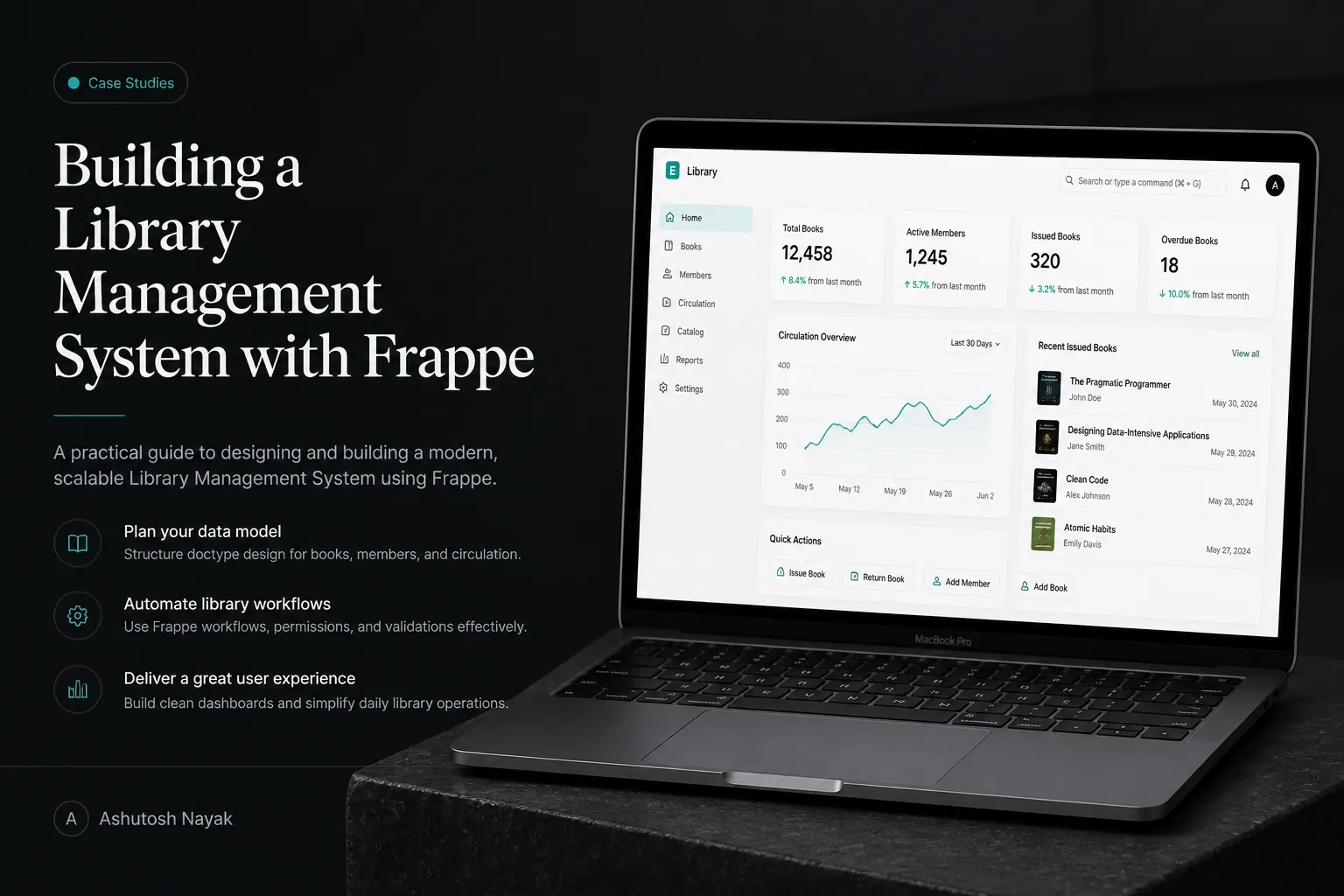
Library operations look simple from the outside — check a book out, check it back in — until you account for reservation queues, overdue fines, membership renewals, and the fact that none of it should require a staff member sitting at a desk all day. This case study walks through how I approached it on the Frappe Framework.
The challenge
The existing process was entirely manual: a physical register for issues and returns, mental math for overdue fines, and no way for members to check book availability without calling. None of that scales past a small collection, and none of it survives staff turnover.
Data model first
Before writing any UI, I mapped the full book lifecycle to DocTypes:
| DocType | Purpose |
|---|---|
Library Book | Catalog entry — title, author, ISBN, availability |
Library Member | Membership record, tier, expiry date |
Book Issue | An active or historical loan |
Book Reservation | A queued request when a book is unavailable |
Getting this right early mattered more than any other decision — every workflow after this point is just state transitions between these four tables.
The member self-service portal
Frappe's website framework lets you expose a subset of DocTypes as a portal without building a separate frontend app. Members log in, see their active loans and fines, and place reservations directly:
# www/my-library/index.py
import frappe

def get_context(context):
    member = frappe.session.user
    context.issues = frappe.get_all(
        "Book Issue",
        filters={"member": member, "status": "Issued"},
        fields=["book_title", "due_date", "fine_amount"],
    )
    context.reservations = frappe.get_all(
        "Book Reservation",
        filters={"member": member, "status": "Pending"},
        fields=["book_title", "queue_position"],
    )
Automating the parts nobody wants to do by hand
Fine calculation, expiry notifications, and reservation-queue advancement all run as scheduled background jobs rather than being triggered by staff action:
def expire_memberships():
    expired = frappe.get_all(
        "Library Member",
        filters={"expiry_date": ["<", frappe.utils.today()], "status": "Active"},
    )
    for member in expired:
        frappe.db.set_value("Library Member", member.name, "status", "Expired")
        frappe.sendmail(
            recipients=[member.email],
            subject="Your library membership has expired",
            message="Please renew to continue borrowing books.",
        )
Reporting
Staff needed a live view of overdue books without opening the desk manager app. A SQL-backed report doctype answers that directly against the database rather than looping through documents in Python, which matters once the catalog grows past a few thousand records:
SELECT
  bi.name AS issue_id,
  lb.title AS book_title,
  lm.member_name,
  bi.due_date,
  DATEDIFF(CURDATE(), bi.due_date) AS days_overdue
FROM `tabBook Issue` bi
JOIN `tabLibrary Book` lb ON lb.name = bi.book
JOIN `tabLibrary Member` lm ON lm.name = bi.member
WHERE bi.status = 'Issued' AND bi.due_date < CURDATE()
ORDER BY days_overdue DESC;
Outcome
The result is a working ERP-style system with real-time dashboards, role-based access control, and zero manual fine calculation. It's still evolving — reservation queue notifications and a mobile-friendly checkout flow are next.
What I'd do differently
Model the reservation queue as an ordered list from day one. I initially tracked queue position as a plain integer field updated on every change, which works fine at low volume but creates race conditions under concurrent reservations — a proper queue table with atomic position updates would have avoided a rewrite.
Related articles

Beyond CRUD: Building Intelligent Search in Frappe/ERPNext
Discover how to go beyond basic search in Frappe/ERPNext by integrating AI-powered semantic search for richer, more intuitive data discovery.

Beyond CRUD: Advanced Frappe/ERPNext Customization with Jinja
Unlock advanced UI customization in Frappe/ERPNext beyond standard CRUD. Learn to leverage Jinja templating for dynamic reports, custom forms, and interactive dashboards.

Boosting ERPNext Efficiency with Custom UI Actions
Learn how to create custom UI actions in Frappe/ERPNext to streamline workflows and enhance user productivity. A practical guide for developers.
Get new articles in your inbox
Occasional writing on AI, ERP and data analytics — no spam, unsubscribe any time.