 Ashutosh Nayak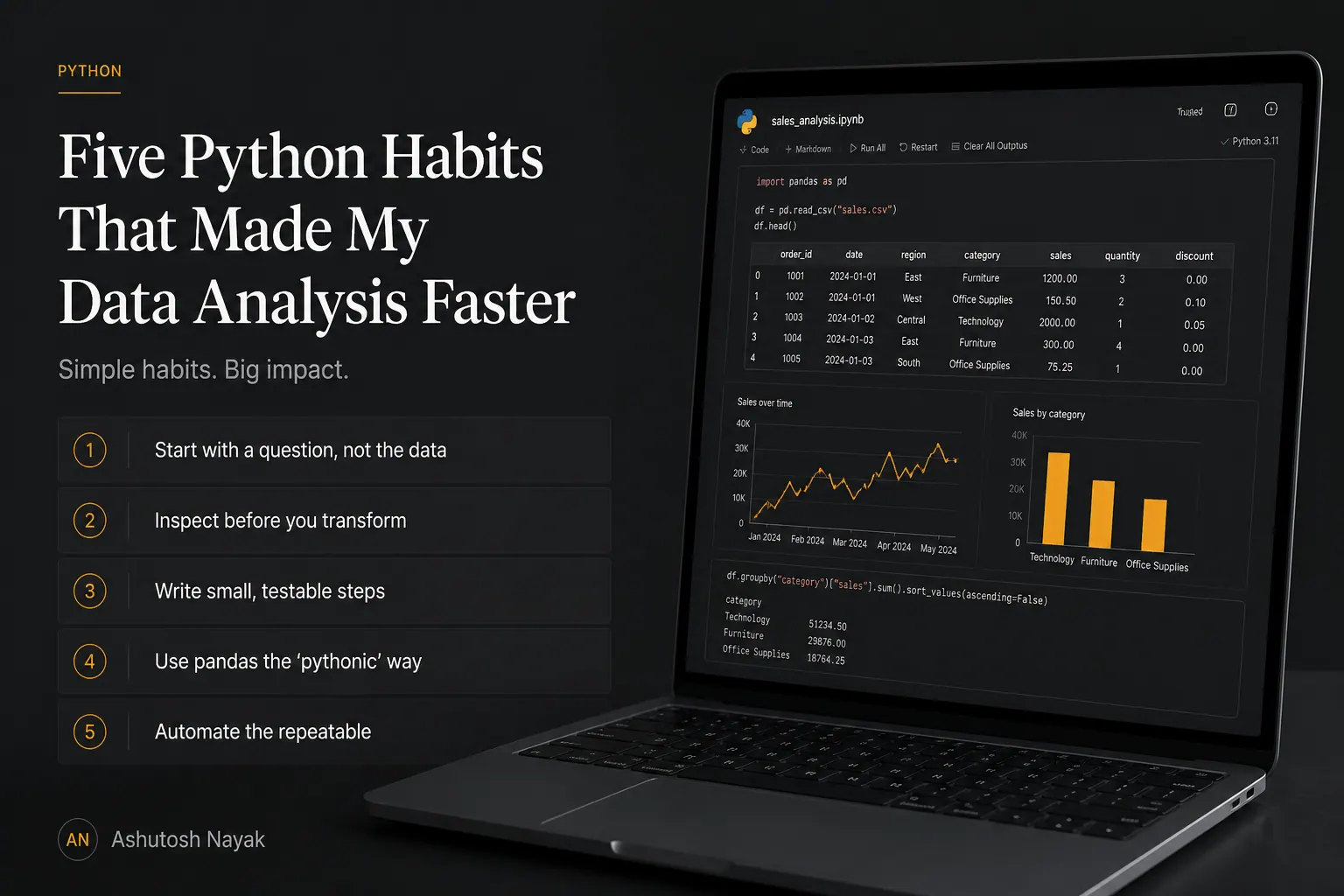
None of these are advanced techniques. They're habits — the kind of thing that saves ten minutes a day and adds up over a year of building dashboards and reports.
1. Push filtering into SQL, not pandas
If the data is already in a database, filter it there. Pulling an entire table into a DataFrame and then calling .query() wastes both memory and time.
import pandas as pd
from sqlalchemy import create_engine

engine = create_engine(DB_URL)
df = pd.read_sql(
    "SELECT * FROM sales WHERE region = %s AND closed_at >= %s",
    engine,
    params=(region, start_date),
)
2. Use categorical dtype for anything low-cardinality
Region names, status flags, product categories — anything with a small, repeating set of values should be a category dtype. It cuts memory usage and speeds up groupby operations on large frames.
df["status"] = df["status"].astype("category")
df["region"] = df["region"].astype("category")
3. Chain, don't reassign
Pandas method chaining reads closer to the mental model of "transform this data" and avoids a pile of intermediate variables that are easy to lose track of.
result = (
    df
    .query("status == 'Closed Won'")
    .groupby("region", observed=True)["deal_value"]
    .sum()
    .sort_values(ascending=False)
)
4. Write a .env-driven config module once
Every analysis script eventually needs a database connection, an output path, and a couple of feature flags. Centralize it once instead of copy-pasting connection strings across notebooks:
# config.py
import os
from dotenv import load_dotenv

load_dotenv()

DB_URL = os.environ["DATABASE_URL"]
OUTPUT_DIR = os.environ.get("OUTPUT_DIR", "./reports")
5. Automate the report, not just the analysis
If a report runs weekly, it should run itself. A simple cron entry beats "remembering" every time:
# crontab -e
0 8 * * MON /usr/bin/python3 /opt/reports/weekly_sales.py
The pattern behind all five
Every one of these is about moving repeated work out of the moment you're doing analysis and into infrastructure you set up once. None of it is exciting, and that's the point — the goal is spending your attention on the analysis itself, not the plumbing around it.
Related articles

Unlocking ERPNext Data with Pandas & Python
Learn how to leverage Python's Pandas library to efficiently extract, clean, and analyze your ERPNext data for deeper business insights.

Python for Business Analysts: Beyond Spreadsheets
Explore how Python empowers business analysts with advanced data analysis, automation, and visualization tools, moving beyond traditional spreadsheet limitations.

Python Generators: Memory Efficiency for Data Pipelines
Learn how Python generators can significantly improve memory efficiency in data processing and analytics, especially for large datasets. Reduce memory footprint and enhance performance.
Get new articles in your inbox
Occasional writing on AI, ERP and data analytics — no spam, unsubscribe any time.