 Ashutosh Nayak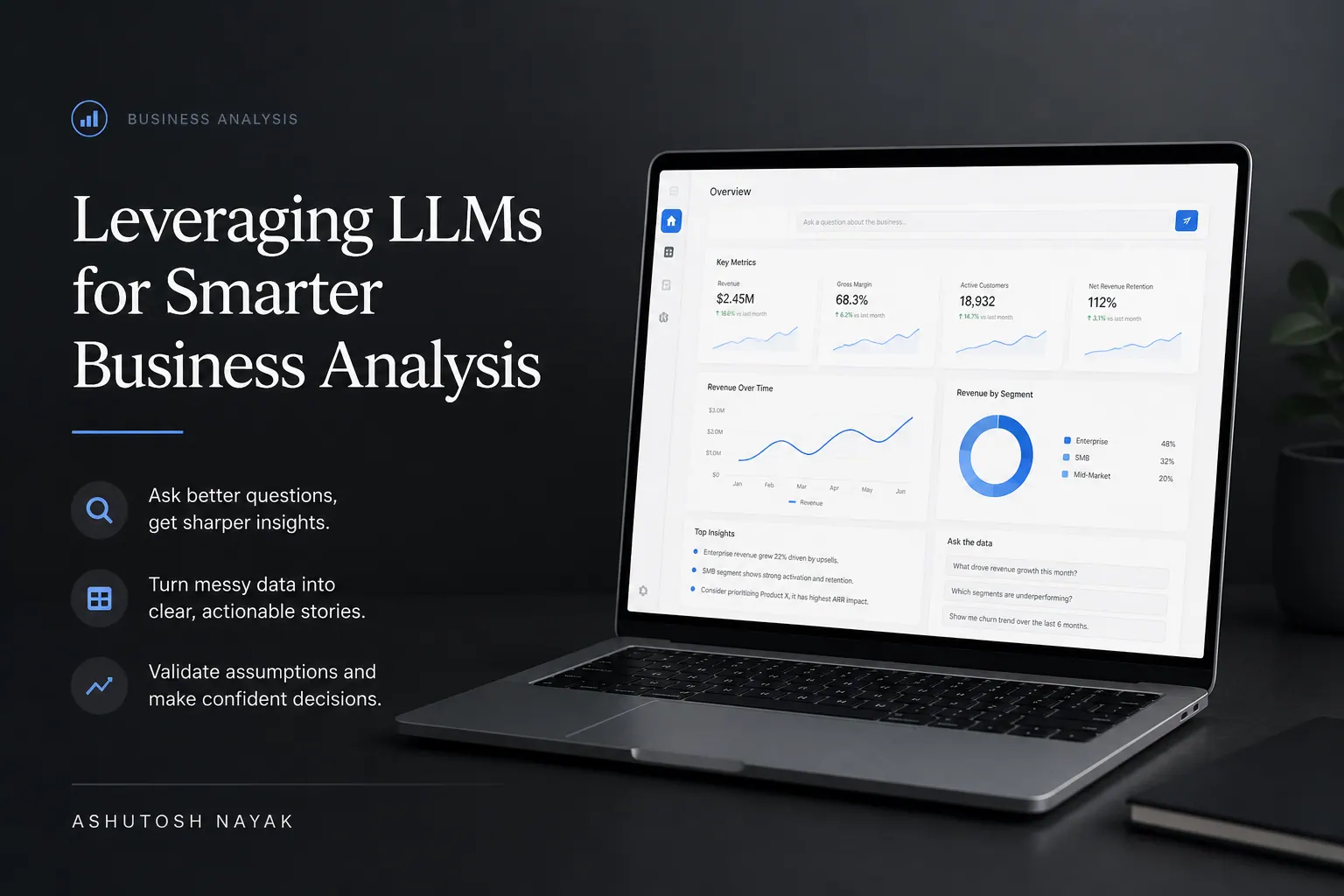
The Evolving Landscape of Business Analysis
Business analysis has always been about bridging the gap between business needs and technological solutions. Traditionally, this involved a meticulous process of requirements gathering, data interpretation, process modeling, and stakeholder communication. While these core tenets remain, the tools and techniques at our disposal are undergoing a seismic shift, largely driven by advancements in Artificial Intelligence (AI), particularly Large Language Models (LLMs).
For professionals like myself, who straddle the worlds of AI/ML engineering, business analysis, and ERPNext/Frappe development, this evolution presents both exciting opportunities and new challenges. The ability to harness the power of LLMs can dramatically enhance the efficiency, accuracy, and depth of business analysis, leading to more informed and impactful strategic decisions.
What are Large Language Models (LLMs)?
Before diving into applications, it's crucial to understand what LLMs are. In essence, LLMs are a type of AI model trained on vast amounts of text data. This training allows them to understand, generate, and manipulate human language with remarkable fluency and coherence. Think of models like GPT-3, GPT-4, BERT, and their successors. They excel at tasks such as text summarization, translation, question answering, code generation, and even creative writing.
Their power lies in their ability to identify patterns, relationships, and nuances within language that are often difficult or time-consuming for humans to discern. This capability is precisely what makes them so potent for business analysis.
Practical Applications of LLMs in Business Analysis
The integration of LLMs into the business analysis workflow isn't a futuristic concept; it's happening now. Here are several practical ways LLMs can be leveraged:
1. Enhanced Requirements Elicitation and Documentation
Traditionally, requirements gathering involves extensive interviews, workshops, and document reviews. LLMs can assist by:
- Summarizing existing documentation: Feed a large volume of legacy documents, meeting transcripts, or user feedback into an LLM, and it can distill the key requirements, pain points, and suggestions, saving analysts significant review time.
- Generating draft user stories and use cases: Based on high-level descriptions of desired functionality, LLMs can generate initial drafts of user stories or detailed use cases, providing a structured starting point for refinement.
- Identifying implicit requirements: By analyzing customer feedback or support tickets, LLMs can identify recurring themes or unstated needs that might be missed in direct questioning.
2. Advanced Data Interpretation and Insight Generation
Business analysts often work with complex datasets. LLMs can augment this by:
- Natural Language Querying of Databases: Imagine being able to ask your database questions in plain English, and get clear, concise answers. LLMs can act as an intermediary, translating natural language queries into SQL (or other query languages) and then interpreting the results back into understandable business terms.
- Sentiment Analysis on Customer Feedback: LLMs can process large volumes of customer reviews, social media posts, and survey responses to gauge sentiment, identify key drivers of satisfaction or dissatisfaction, and highlight emerging trends.
- Automated Report Generation: While not a full replacement for human analysis, LLMs can draft initial versions of business reports by synthesizing data from various sources, identifying key metrics, and suggesting potential interpretations. This frees up analysts to focus on the strategic implications rather than the laborious task of data compilation.
3. Process Mapping and Optimization Assistance
Understanding and improving business processes is a core BA function. LLMs can contribute by:
- Analyzing process descriptions: If processes are documented in text, LLMs can help identify bottlenecks, redundancies, or deviations from best practices.
- Suggesting process improvements: Based on analysis of current state descriptions and desired outcomes, LLMs can propose potential improvements or alternative process flows.
4. Stakeholder Communication and Knowledge Management
Effective communication is paramount. LLMs can assist in:
- Drafting communications: Generating emails, presentations, or summaries tailored to different stakeholder groups.
- Creating FAQs and knowledge base articles: Automatically generating answers to common questions based on project documentation or existing knowledge bases.
- Translating technical jargon: Helping to translate complex technical details into business-friendly language for non-technical stakeholders, and vice versa.
The Role of the Business Analyst in the LLM Era
It's important to address a common concern: will LLMs replace business analysts? The answer is a resounding no, but their role will undoubtedly evolve. Instead of replacing analysts, LLMs will act as powerful co-pilots.
Analysts will need to shift their focus from rote tasks to higher-level strategic thinking, critical evaluation, and complex problem-solving. Key skills will include:
- Prompt Engineering: Mastering the art of crafting effective prompts to elicit the desired output from LLMs.
- Critical Evaluation: Understanding the limitations of LLMs and critically assessing their outputs for accuracy, bias, and relevance.
- Domain Expertise: Deepening business domain knowledge to guide LLM applications and interpret results contextually.
- Ethical Considerations: Understanding and addressing the ethical implications of using AI, such as data privacy and algorithmic bias.
- Integration Skills: Knowing how to integrate LLM capabilities into existing business analysis tools and workflows, perhaps even within platforms like ERPNext/Frappe.
Bridging the Gap: LLMs and ERPNext/Frappe Development
For those of us working with Frappe and ERPNext, the potential for LLM integration is particularly exciting. Imagine:
- Automated data validation rules: LLMs could analyze transaction patterns and suggest new validation rules to ensure data integrity within ERPNext.
- Smart report builders: Users could describe the report they need in natural language, and an LLM could help configure it within ERPNext.
- AI-powered chatbot support: An LLM-driven chatbot integrated into Frappe could provide instant answers to common user queries about system functionality or data.
- Automated documentation generation for custom modules: LLMs could assist developers by generating initial documentation for custom Frappe applications.
This synergy between business analysis, AI, and the robust framework of Frappe/ERPNext could lead to unprecedented levels of efficiency and intelligence within business operations.
Challenges and the Road Ahead
Despite the immense potential, challenges remain. These include ensuring data privacy and security when using LLMs, mitigating inherent biases within the models, managing the cost of inference, and the ongoing need for human oversight. Furthermore, the rapid pace of LLM development means continuous learning is essential.
Conclusion
Large Language Models are not just a technological novelty; they represent a fundamental shift in how we can approach business analysis. By embracing LLMs, business analysts can move beyond data crunching to become more strategic partners, driving innovation and informed decision-making. The key lies in understanding their capabilities, integrating them thoughtfully into existing workflows, and cultivating the necessary skills to leverage them effectively. As an AI & ML Engineer and Frappe/ERPNext Developer, I see LLMs as powerful allies in building more intelligent, efficient, and data-driven businesses. The future of business analysis is collaborative – human ingenuity augmented by artificial intelligence.
Related articles

Bridging Business Gaps with LLMs: Beyond Code
Discover how Large Language Models can transform business analysis, streamlining workflows and uncovering insights beyond traditional methods.

Leveraging LLMs for Enhanced Business Process Discovery
Explore how Large Language Models (LLMs) can revolutionize business process discovery, moving beyond traditional methods to uncover hidden inefficiencies and opportunities.

Leveraging AI for Smarter Business Analysis
Discover how AI and ML techniques can revolutionize business analysis, providing deeper insights and driving more informed strategic decisions.
Get new articles in your inbox
Occasional writing on AI, ERP and data analytics — no spam, unsubscribe any time.