 Ashutosh Nayak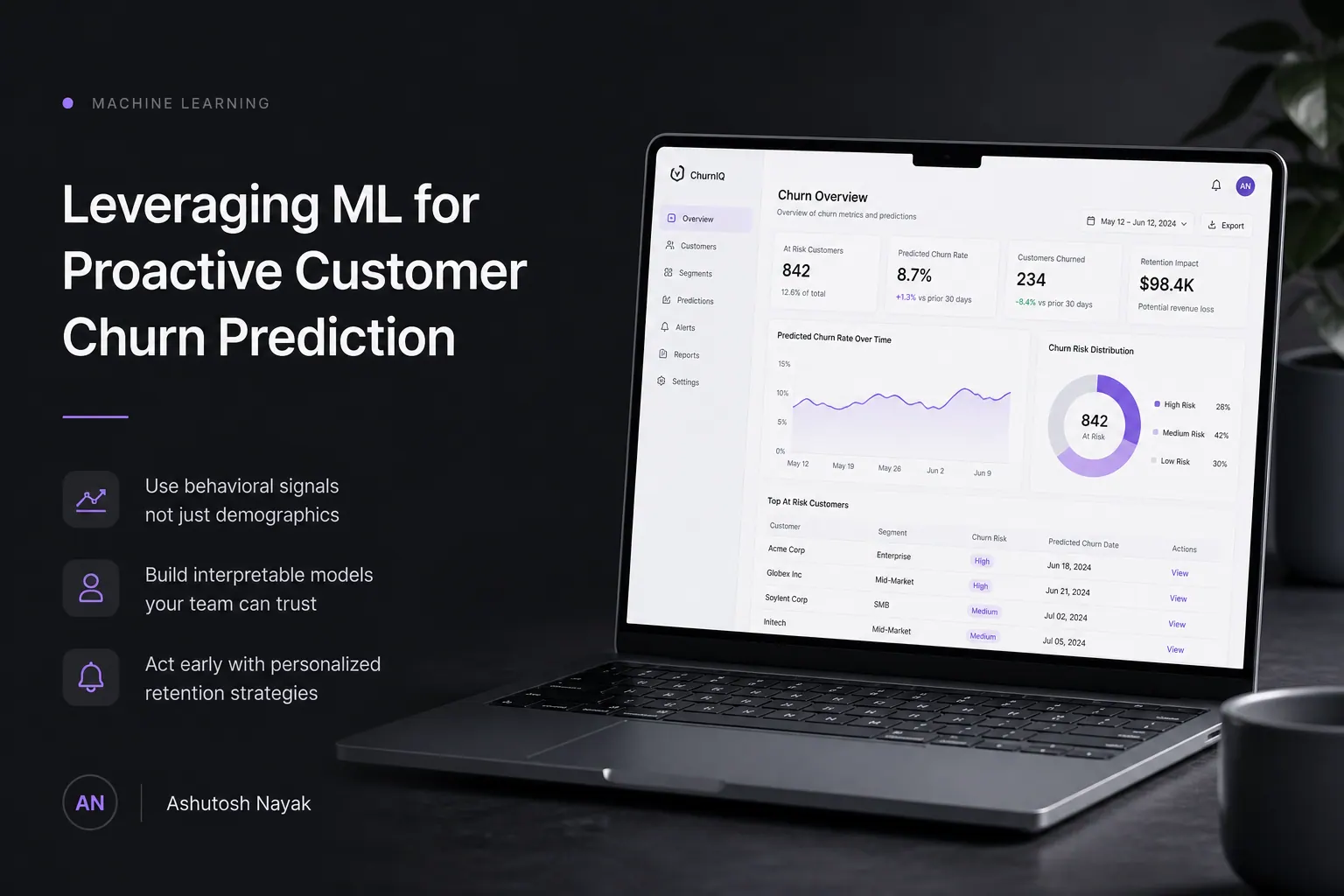
The Ever-Present Challenge of Customer Churn
In today's competitive business landscape, customer acquisition is expensive. Consequently, retaining existing customers is paramount for sustainable growth and profitability. Customer churn, the phenomenon of customers ceasing to do business with a company, represents a significant threat to revenue streams and market share. Traditional methods of identifying at-risk customers often rely on intuition, reactive measures, or simple demographic analysis, which can be insufficient in pinpointing the subtle indicators of impending churn.
This is where the power of Machine Learning (ML) shines. By analyzing historical customer data, ML algorithms can identify complex patterns and predict which customers are most likely to churn. This allows businesses to proactively intervene with targeted retention strategies, significantly improving customer lifetime value and reducing the costly cycle of acquisition and loss.
Why Machine Learning for Churn Prediction?
Machine learning offers a data-driven and systematic approach to churn prediction, moving beyond guesswork. Its ability to process vast amounts of data and uncover non-obvious correlations makes it ideal for this task. Unlike rule-based systems, ML models can adapt and improve over time as more data becomes available, offering increasingly accurate predictions.
Key advantages of using ML for churn prediction include:
- Early Detection: Identify at-risk customers long before they actively show signs of leaving.
- Personalized Interventions: Understand the specific reasons a customer might churn and tailor retention efforts accordingly.
- Resource Optimization: Focus retention efforts and resources on the customers who need them most.
- Improved Customer Experience: By addressing potential issues proactively, businesses can enhance overall customer satisfaction.
The Churn Prediction Pipeline: A Step-by-Step Approach
Building an effective churn prediction model involves a structured pipeline, from data collection to model deployment and monitoring.
1. Problem Definition and Goal Setting
Before diving into the data, clearly define what constitutes 'churn' for your business. Is it a customer not renewing a subscription? A customer not making a purchase within a certain period? Setting a precise definition is crucial for accurate labeling of your data. The ultimate goal is to develop a model that can predict the probability of a customer churning within a defined future timeframe.
2. Data Collection and Preparation
This is arguably the most critical and time-consuming phase. You need to gather relevant data that might influence a customer's decision to leave. This typically includes:
- Demographic Data: Age, location, profession, etc.
- Behavioral Data: Website activity, purchase history, product usage, interaction frequency, support ticket history, engagement with marketing campaigns.
- Transactional Data: Payment history, subscription details, contract terms, service plan.
- Customer Feedback: Survey responses, reviews, social media sentiment.
Once collected, the data needs rigorous cleaning and preprocessing:
- Handling Missing Values: Impute missing data points using appropriate strategies (e.g., mean, median, mode imputation, or more sophisticated methods).
- Feature Engineering: Create new, more informative features from existing ones. For instance, 'average time between purchases' or 'number of support interactions in the last quarter' can be powerful predictors.
- Data Transformation: Scale numerical features to ensure they have similar ranges (e.g., using StandardScaler or MinMaxScaler). Encode categorical features into numerical representations (e.g., one-hot encoding).
- Handling Imbalanced Data: Churn datasets are often imbalanced (many more non-churners than churners). Techniques like oversampling (SMOTE), undersampling, or using cost-sensitive learning can address this.
3. Feature Selection
Not all collected features will be equally useful. Feature selection aims to identify the most relevant features that contribute to churn prediction, reducing noise and improving model performance and interpretability. Techniques include:
- Filter Methods: Based on statistical measures (e.g., correlation, mutual information).
- Wrapper Methods: Use a specific ML model to evaluate subsets of features.
- Embedded Methods: Feature selection is built into the model training process (e.g., L1 regularization in Lasso).
4. Model Selection
Several ML algorithms are well-suited for binary classification tasks like churn prediction. Common choices include:
- Logistic Regression: A simple yet effective linear model that provides interpretable probabilities.
- Decision Trees: Easy to understand and visualize, good for capturing non-linear relationships.
- Random Forests: An ensemble of decision trees, robust to overfitting and generally high-performing.
- Gradient Boosting Machines (e.g., XGBoost, LightGBM): Powerful algorithms known for their accuracy and efficiency.
- Support Vector Machines (SVMs): Effective in high-dimensional spaces, but can be computationally intensive.
Often, starting with simpler models and progressively trying more complex ones is a good strategy.
5. Model Training and Evaluation
Split your prepared data into training and testing sets (e.g., 80% train, 20% test). Train the selected model(s) on the training data. Evaluation is crucial to understand how well your model performs on unseen data.
Standard evaluation metrics for classification include:
- Accuracy: Overall correct predictions (can be misleading with imbalanced data).
- Precision: Of those predicted to churn, how many actually churned (avoids false positives).
- Recall (Sensitivity): Of those who actually churned, how many were correctly predicted (avoids false negatives).
- F1-Score: The harmonic mean of Precision and Recall, providing a balanced measure.
- AUC-ROC Curve: Measures the model's ability to distinguish between churners and non-churners across various thresholds.
Cross-validation is essential to ensure the model's performance is consistent and not dependent on a specific train-test split.
6. Model Deployment and Monitoring
Once a satisfactory model is trained and evaluated, it needs to be deployed into a production environment. This could involve integrating it into a CRM system, an analytics dashboard, or an automated marketing platform.
Crucially, the model's performance must be continuously monitored. Customer behavior changes, and the model can become stale over time (model drift). Regular retraining with new data is necessary to maintain accuracy. Monitoring also involves tracking the effectiveness of the retention strategies implemented based on the model's predictions.
Implementing Retention Strategies
Predicting churn is only half the battle. The insights gained from the ML model must drive actionable retention strategies. These can be highly personalized based on the predicted reasons for churn:
- Proactive Outreach: For customers showing early signs of disengagement, a customer success manager can reach out to offer support or discuss their experience.
- Targeted Offers: For customers exhibiting price sensitivity, special discounts or loyalty programs can be offered.
- Improved Onboarding/Support: If churn indicators point to issues with product understanding or support, enhanced onboarding materials or priority support can be provided.
- Feedback Loop: Use the churn prediction model to identify common pain points and feed this information back to product development and customer service teams.
Conclusion: A Proactive Path to Customer Loyalty
Customer churn is an inherent business challenge, but it doesn't have to be an insurmountable one. By harnessing the power of machine learning, businesses can move from reactive damage control to proactive customer retention. The process requires careful planning, robust data handling, thoughtful model selection, and continuous monitoring. However, the rewards – increased customer lifetime value, reduced acquisition costs, and a stronger, more loyal customer base – make it a worthwhile investment for any data-savvy organization.
As an AI & ML Engineer, Business Analyst, and ERPNext Developer, I see immense potential in integrating such predictive capabilities directly within business management systems like ERPNext. Imagine automatically flagging at-risk customers within your CRM module, triggering automated workflows for retention efforts. This synergy between data science and business operations is the future of intelligent business management.
Get new articles in your inbox
Occasional writing on AI, ERP and data analytics — no spam, unsubscribe any time.