 Ashutosh Nayak
The Evolving Landscape of Business Analysis
Business analysis has long been the bridge between complex business needs and actionable technical solutions. Traditionally, this involved meticulous documentation, stakeholder interviews, process mapping, and data analysis. While these core skills remain indispensable, the advent of sophisticated Artificial Intelligence, particularly Large Language Models (LLMs), is rapidly reshaping how business analysts operate and the value they can deliver.
We're moving beyond a purely code-centric view of AI integration. LLMs offer a paradigm shift, enabling us to leverage their linguistic and reasoning capabilities to augment the human analyst, not replace them. For professionals like myself, blending expertise in AI/ML, business analysis, and platforms like Frappe/ERPNext, this presents an exciting opportunity to redefine business processes and unlock deeper insights.
This post will explore how LLMs can empower business analysts, moving beyond simple task automation to truly enhance strategic decision-making and operational efficiency. We'll delve into practical applications, focusing on how these models can assist in areas like requirement gathering, competitive analysis, risk assessment, and even communication.
Requirement Elicitation: The Power of Natural Language Understanding
One of the most time-consuming yet critical aspects of business analysis is requirement elicitation. Gathering accurate, complete, and unambiguous requirements from stakeholders, often through interviews and workshops, can be challenging. LLMs, with their advanced Natural Language Understanding (NLU) capabilities, can significantly streamline this process.
Imagine feeding interview transcripts or raw meeting notes to an LLM. The model can then:
- Identify Key Themes and Topics: Automatically extract the main subjects discussed, saving analysts hours of manual review.
- Summarize Complex Discussions: Condense lengthy conversations into concise summaries, highlighting crucial decisions and action items.
- Detect Ambiguities and Gaps: Flag statements that are vague, contradictory, or incomplete, prompting the analyst to seek clarification.
- Generate Draft User Stories: Based on the gathered information, LLMs can draft initial user stories or functional requirements, providing a solid starting point for refinement.
- Translate Technical Jargon: Assist in translating complex technical explanations into business-friendly language, ensuring all stakeholders understand the implications.
This doesn't mean the analyst steps away. Instead, the LLM acts as a tireless, intelligent assistant, processing vast amounts of textual data rapidly and identifying patterns that a human might miss or take much longer to uncover. The analyst can then focus their energy on critical thinking, probing deeper into areas flagged by the AI, and ensuring the requirements truly align with business objectives.
Competitive Analysis and Market Research Amplified
Understanding the competitive landscape and market trends is vital for strategic planning. Traditionally, this involves sifting through company reports, news articles, analyst briefings, and competitor websites. LLMs can dramatically accelerate and deepen this process.
By querying LLMs with specific prompts, analysts can:
- Synthesize Competitor Strategies: Ask the LLM to analyze publicly available information about competitors and summarize their go-to-market strategies, product offerings, and pricing models.
- Identify Emerging Market Trends: Prompt the model to scan recent industry publications and news to identify and summarize emerging trends, potential disruptors, and shifts in customer preferences.
- Analyze Customer Sentiment: Process customer reviews and social media data to gauge sentiment towards specific products or services, identifying areas of strength and weakness.
- Generate SWOT Analyses: Based on provided company information and market data, LLMs can help draft preliminary Strengths, Weaknesses, Opportunities, and Threats (SWOT) analyses.
The LLM's ability to process and synthesize information from diverse sources at scale allows business analysts to gain a more comprehensive and up-to-date understanding of their market, enabling more informed strategic decisions.
Risk Assessment and Mitigation Strategies
Identifying potential risks and developing mitigation plans is another cornerstone of business analysis. LLMs can contribute significantly to this area by analyzing historical data, project documentation, and even external risk factors.
Consider these applications:
- Analyzing Project Post-Mortems: Feed previous project failure reports or lessons learned documents into an LLM to identify recurring risk patterns and common causes of project delays or overruns.
- Scenario Planning: Use LLMs to generate plausible future scenarios based on current trends and potential disruptions, helping teams anticipate challenges.
- Regulatory Compliance Checks: While not a substitute for legal counsel, LLMs can be prompted to identify potential compliance issues based on project descriptions and relevant regulations, flagging areas for closer inspection.
- Proposing Mitigation Steps: Based on identified risks, LLMs can suggest a range of potential mitigation strategies, drawing from best practices and historical data.
This allows analysts to be more proactive in identifying and addressing risks, ultimately leading to more successful project outcomes and more resilient business operations.
Enhancing Communication and Knowledge Management
Effective communication is paramount in business analysis. LLMs can act as powerful tools to enhance how information is shared and managed.
- Drafting Executive Summaries: Quickly generate concise summaries of complex reports or analyses for executive review.
- Creating Training Materials: Assist in developing documentation, FAQs, or training modules based on project specifications or process descriptions.
- Facilitating Knowledge Discovery: Employees can query an internal knowledge base powered by an LLM to find information quickly, improving self-service and reducing reliance on specific individuals.
- Simplifying Technical Documentation: Translate complex technical specifications into more accessible language for non-technical audiences.
By improving the clarity, accessibility, and discoverability of information, LLMs help ensure that all stakeholders are aligned and well-informed.
The Analyst's Role in an LLM-Augmented World
It's crucial to emphasize that LLMs are tools to augment, not replace, the business analyst. The human analyst brings critical thinking, domain expertise, emotional intelligence, and the ability to build relationships – qualities that AI currently cannot replicate.
In an LLM-augmented world, the business analyst's role evolves:
- Prompt Engineering: Developing effective prompts to elicit the desired information and insights from LLMs becomes a key skill.
- Critical Evaluation: Analysts must critically evaluate the output of LLMs, verifying information, identifying biases, and ensuring accuracy.
- Strategic Interpretation: The real value lies in the analyst's ability to interpret the LLM's output within the broader business context and translate it into strategic recommendations.
- Ethical Oversight: Ensuring the responsible and ethical use of AI, particularly concerning data privacy and bias, remains the analyst's responsibility.
Conclusion: Embracing the Future of Business Analysis
The integration of LLMs into the business analysis toolkit is not a distant possibility; it is a present reality. For professionals who combine technical acumen with business understanding, like those working with platforms such as Frappe/ERPNext, this presents an unparalleled opportunity. By embracing LLMs, business analysts can move beyond simply documenting processes to actively shaping strategy, uncovering hidden opportunities, mitigating risks more effectively, and driving greater business value. The future of business analysis is intelligent, collaborative, and more impactful than ever before.
Related articles
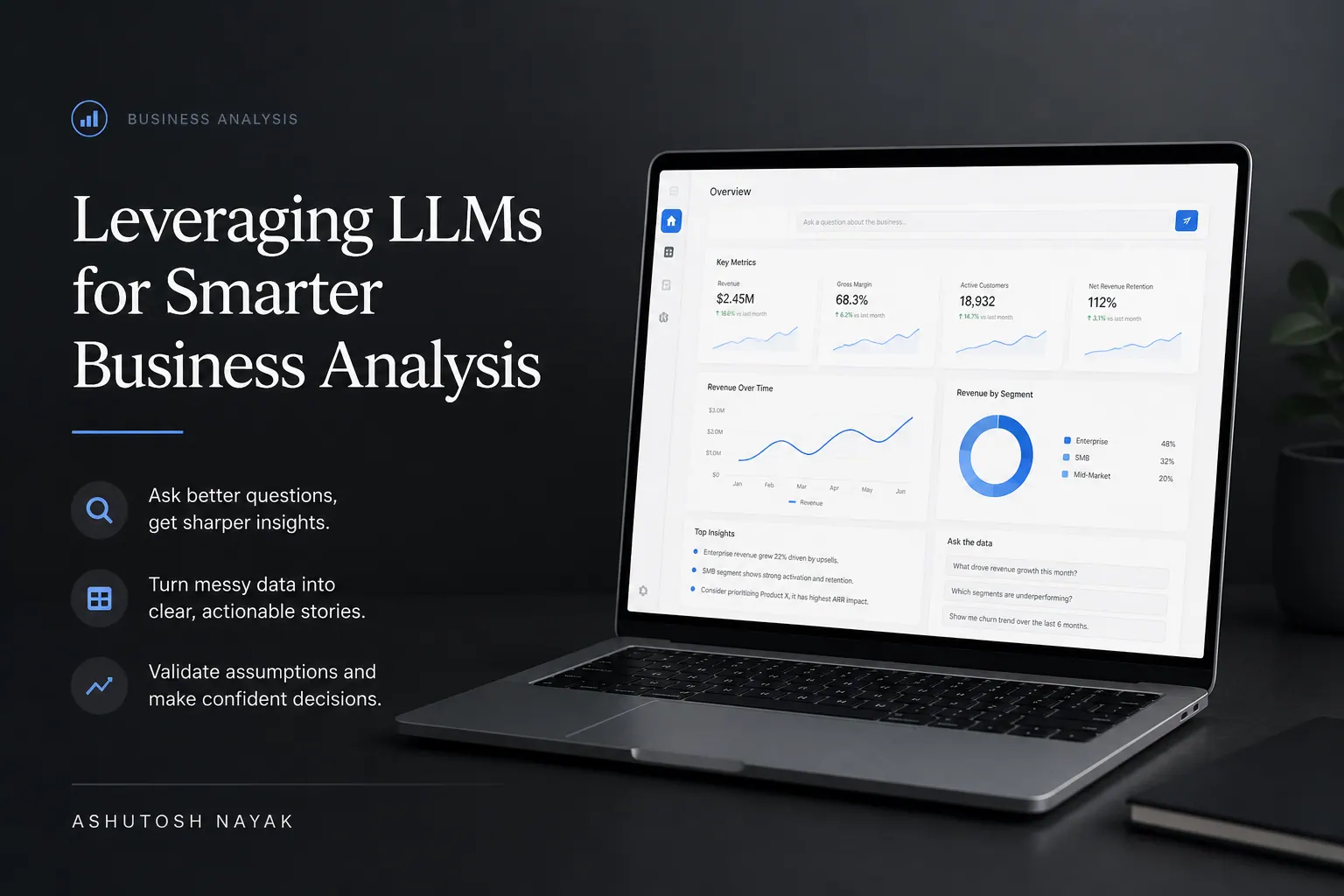
Leveraging LLMs for Smarter Business Analysis
Discover how Large Language Models (LLMs) can revolutionize your business analysis, from data interpretation to strategic decision-making. Explore practical applications and future potential.

Leveraging LLMs for Enhanced Business Process Discovery
Explore how Large Language Models (LLMs) can revolutionize business process discovery, moving beyond traditional methods to uncover hidden inefficiencies and opportunities.

Optimizing ERPNext Workflows with Business Process Modeling
Learn how Business Process Modeling (BPM) can enhance ERPNext efficiency, streamline operations, and improve decision-making for your business.
Get new articles in your inbox
Occasional writing on AI, ERP and data analytics — no spam, unsubscribe any time.