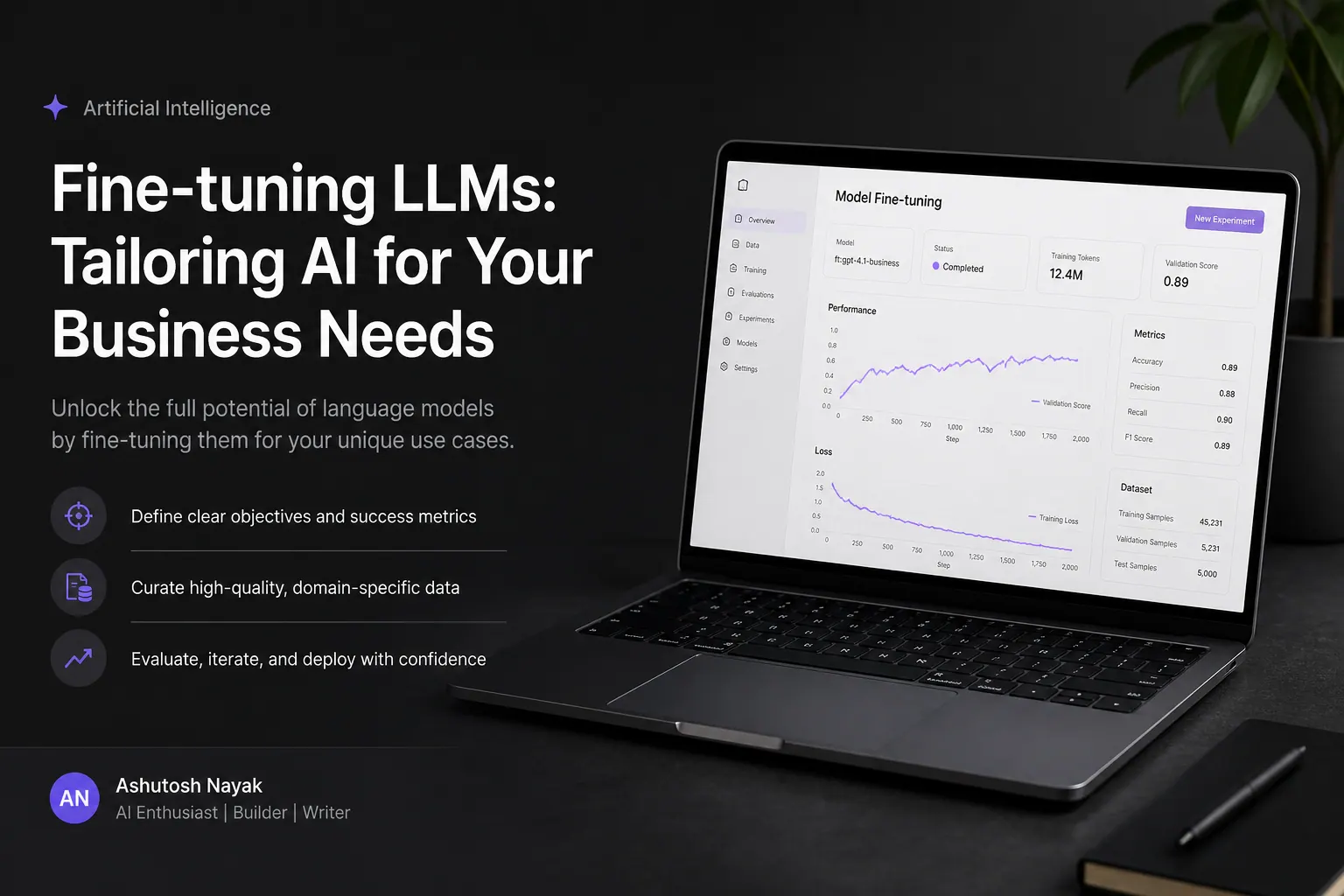
Large Language Models (LLMs) have revolutionized how we interact with and generate text. From chatbots to content creation, their capabilities are vast. However, out-of-the-box LLMs, while powerful, are often trained on general-purpose data. For many specific business needs or niche applications, this general knowledge isn't enough. This is where fine-tuning comes in.
Fine-tuning is the process of taking a pre-trained LLM and further training it on a smaller, domain-specific dataset. This allows the model to adapt its knowledge and behavior to a particular task or industry, significantly improving its performance and relevance. As an AI & ML Engineer, understanding fine-tuning is crucial for leveraging LLMs effectively beyond their general capabilities.
This guide will walk you through the practical steps and considerations involved in fine-tuning LLMs, making it accessible for developers looking to build specialized AI solutions.
Before diving into the 'how,' let's establish the 'why.' Why invest time and resources into fine-tuning when pre-trained models are readily available?
Domain Specialization: Generic LLMs lack deep knowledge of highly specialized fields like legal jargon, medical terminology, or specific engineering disciplines. Fine-tuning on relevant datasets imbues the model with this expertise.
Task Adaptation: An LLM might be great at summarizing, but perhaps you need it to excel at a very specific summarization task, like generating concise product descriptions from lengthy technical manuals. Fine-tuning tailors the model's output to your exact requirements.
Improved Accuracy and Relevance: By training on data that mirrors your intended use case, you reduce the chances of irrelevant or incorrect responses. The model learns the nuances, tone, and specific vocabulary of your domain.
Brand Voice and Tone: For customer-facing applications, maintaining a consistent brand voice is critical. Fine-tuning can help an LLM adopt a specific writing style, ensuring brand alignment.
Cost-Effectiveness (in certain scenarios): While fine-tuning requires resources, it can sometimes be more cost-effective than training a model from scratch, especially for smaller, targeted improvements. It also reduces the inference cost compared to using very large general-purpose models for every task.
Understanding a few core concepts will make the process smoother:
Pre-trained Model: This is the foundational LLM (e.g., GPT-3, Llama, BERT) that has already undergone massive training on a broad corpus of text and code. You'll start with one of these.
Dataset: This is your curated collection of examples. For fine-tuning, it typically consists of input-output pairs. For example, if you want to fine-tune a model for question answering in your company's internal documentation, your dataset might contain pairs of questions and their corresponding answers extracted from that documentation.
Training Objective: This defines what the model is trying to learn. For most LLM fine-tuning, it's about predicting the next token in a sequence, given the preceding context.
Hyperparameters: These are settings that control the training process itself, such as the learning rate, batch size, and number of training epochs.
Evaluation Metrics: How do you know if your fine-tuning is successful? Metrics like perplexity, BLEU score, ROUGE score, or task-specific accuracy are used to measure performance.
This is arguably the most critical step. The quality and relevance of your data directly impact the fine-tuned model's performance.
Data Collection: Gather data relevant to your objective. This could be internal documents, customer interactions, expert annotations, or publicly available domain-specific datasets.
Data Formatting: LLMs often expect data in specific formats. A common format is JSON, where each entry might represent a training example. For instance:
[
  {"instruction": "Summarize the following product review:", "input": "This laptop has an amazing battery life and a crisp display, but the keyboard feels a bit cramped.", "output": "Positive review highlighting excellent battery and display, with a minor note on keyboard comfort."}
]
For instruction-following models, the instruction, input, and output fields are common. For simpler tasks like classification, it might be text and label.
Data Cleaning: Remove noise, duplicates, irrelevant information, and correct errors. Ensure consistency in formatting and language.
Data Splitting: Divide your dataset into training, validation, and (optionally) test sets. The validation set is used to monitor performance during training and tune hyperparameters, while the test set provides a final, unbiased evaluation.
Several open-source LLMs are available for fine-tuning (e.g., Llama 2, Mistral, Falcon). Libraries like Hugging Face's transformers are indispensable tools for this process.
Considerations when choosing a model:
Size and Capability: Larger models are more capable but require more computational resources.
License: Ensure the model's license permits your intended use.
Architecture: Some architectures are better suited for certain tasks.
Hugging Face transformers provides models, tokenizers, and training utilities that streamline the fine-tuning process.
Fine-tuning LLMs can be computationally intensive. You'll likely need:
Hardware: GPUs are essential for accelerating the training process. Cloud platforms like AWS, GCP, or Azure offer GPU instances. Services like Google Colab also provide free (with limitations) GPU access for experimentation.
Software: Python is the standard. Install necessary libraries: transformers, torch or tensorflow, datasets, accelerate, etc.
Using a framework like Hugging Face transformers, you'll typically:
Load the pre-trained model and tokenizer.
Tokenize your prepared dataset.
Define training arguments: This includes setting the learning rate, number of epochs, batch size, output directory, and potentially enabling features like gradient accumulation or mixed precision (e.g., fp16) to save memory and speed up training.
Instantiate a Trainer object (or a custom training loop).
Start training. Monitor loss on the training and validation sets.
After training, evaluate the model's performance using your chosen metrics on the validation/test set. If performance is satisfactory:
Save the fine-tuned model.
Deploy the model: This could involve creating an API endpoint using frameworks like FastAPI, Flask, or leveraging managed AI services on cloud platforms.
Iterate on the dataset and training parameters if performance isn't meeting your expectations.
Parameter-Efficient Fine-Tuning (PEFT): Techniques like LoRA (Low-Rank Adaptation) allow you to fine-tune only a small fraction of the model's parameters, drastically reducing computational cost and memory usage while achieving comparable results to full fine-tuning.
Instruction Tuning: Specifically training models on instruction-response pairs to make them better at following natural language instructions.
Reinforcement Learning from Human Feedback (RLHF): A more complex technique that involves training a reward model and then using reinforcement learning to align the LLM's outputs with human preferences.
Quantization: Reducing the precision of the model's weights to decrease memory footprint and speed up inference, often done after fine-tuning.
Fine-tuning LLMs is a powerful technique that transforms general-purpose AI into specialized tools tailored for specific business needs. By carefully preparing your data, choosing the right model, and leveraging available frameworks, you can unlock significant improvements in accuracy, relevance, and performance. As an AI & ML Engineer, mastering this skill set is essential for building cutting-edge applications that drive tangible business value. Start small, iterate, and experiment to discover the full potential of fine-tuned LLMs for your projects.
 Ashutosh Nayak