 Ashutosh Nayak
The Art and Science of Prompt Engineering
Large Language Models (LLMs) have revolutionized how we interact with AI, offering unprecedented capabilities in text generation, summarization, translation, and more. However, harnessing their full potential often hinges on a crucial skill: prompt engineering. Think of prompt engineering as the art of communicating effectively with an AI model. It's about crafting precise, unambiguous, and contextually rich instructions (prompts) that guide the LLM to produce the desired output. Without it, even the most powerful LLM can yield suboptimal, irrelevant, or even nonsensical results.
This post will delve into the core principles and practical techniques of prompt engineering, empowering you to extract more value from LLMs for your business analysis, development, and AI initiatives.
Why Prompt Engineering Matters
LLMs are trained on massive datasets, giving them a broad understanding of language and the world. However, they lack inherent intent or a specific goal for any given interaction. The prompt is the sole driver of their behavior in a specific instance. A well-crafted prompt acts as a clear set of instructions, setting the context, defining the task, and specifying the desired format, tone, and constraints for the output.
Consider the difference between asking an LLM to "write about AI" versus "Write a concise, 200-word summary of the ethical implications of generative AI for a business audience, focusing on potential biases and job displacement."
The first prompt is vague and could lead to a rambling, unfocused response. The second prompt is specific, providing context (business audience), a length constraint (200 words), and a clear focus (ethical implications, bias, job displacement). This specificity is the essence of effective prompt engineering.
Key Principles of Effective Prompting
Several fundamental principles underpin successful prompt engineering:
1. Clarity and Specificity
Ambiguity is the enemy of good LLM output. Be explicit about what you want. Instead of asking for "information," ask for "a list of the top 5 ERP systems for small manufacturing businesses in 2023."
2. Context is King
Provide sufficient background information. If you're asking the LLM to act as a persona (e.g., a financial analyst), tell it that. If you're asking it to summarize a document, provide the document.
3. Define the Output Format
Specify how you want the information presented. Do you need bullet points, a JSON object, a paragraph, a table, or a specific code structure? For example: "Provide the key features of Python libraries for data visualization in a JSON format, with each object containing 'name', 'description', and 'use_case' keys."
4. Set Constraints and Requirements
Specify length limits, tone (formal, informal, technical), keywords to include or avoid, and the target audience. "Write a marketing email to potential Frappe users, keeping it under 150 words, emphasizing ease of customization and affordability. Avoid technical jargon."
5. Iteration and Refinement
Prompt engineering is often an iterative process. Your first prompt might not yield perfect results. Analyze the output, identify shortcomings, and refine your prompt accordingly. This might involve adding more detail, rephrasing instructions, or providing examples.
Advanced Prompt Engineering Techniques
Beyond the basic principles, several advanced techniques can significantly enhance LLM performance:
Few-Shot Prompting
This technique involves providing the LLM with a few examples of the desired input-output pair before asking it to perform the actual task. This helps the model understand the pattern and desired style.
Example: Imagine you want to extract company names and their founding years from text.
Text: "Google was founded in 1998 by Larry Page and Sergey Brin."
Company: Google
Year: 1998

Text: "Microsoft, established in 1975, is a tech giant."
Company: Microsoft
Year: 1975

Text: "Apple Inc. began its journey in 1976."
Company: Apple Inc.
Year: 1976

Text: "Amazon was launched in 1994 by Jeff Bezos."
Company:
Year:
The LLM is more likely to correctly identify "Amazon" and "1994" after seeing the previous examples.
Chain-of-Thought (CoT) Prompting
CoT prompting encourages the LLM to break down a complex problem into intermediate steps, mimicking human reasoning. This is particularly useful for mathematical or logical problems.
Example: "Q: Roger has 5 tennis balls. He buys 2 more cans of tennis balls. Each can has 3 tennis balls. How many tennis balls does he have now? A: Roger started with 5 balls. 2 cans of 3 balls each is 2 * 3 = 6 balls. So he has 5 + 6 = 11 balls. The answer is 11."
By including the step-by-step reasoning in the prompt (often through examples), you guide the LLM to perform similar reasoning for new problems.
Role-Playing and Persona Assignment
Instructing the LLM to adopt a specific persona can significantly alter its output style and focus. As mentioned earlier, asking it to act as a "senior business analyst" or a "Python programming tutor" will shape its responses.
Negative Constraints
Explicitly stating what you don't want can be as effective as stating what you do want. "Summarize the article, but do not include any direct quotes."
Practical Applications in Your Workflow
As an AI & ML Engineer, Business Analyst, and Frappe/ERPNext Developer, prompt engineering is invaluable:
- Business Analysis: Generate market research summaries, draft business proposals, analyze customer feedback sentiment, create user stories from requirements.
- ERPNext/Frappe Development: Generate boilerplate code for custom modules, draft documentation for custom scripts, translate business logic into pseudo-code, help debug code snippets by explaining potential issues.
- AI/ML Projects: Prototype AI features, generate synthetic data for training, explain complex ML concepts in simple terms, assist in writing research summaries.
- Python Development: Generate Python functions for specific tasks, write unit tests, explain code logic, refactor code snippets.
Tools and Platforms
Many platforms offer access to LLMs and varying degrees of prompt management features. Tools like OpenAI's Playground, Google AI Studio, and LangChain provide environments to experiment with prompts and build applications powered by LLMs. Understanding how these platforms implement prompts can also inform your technique.
Conclusion
Prompt engineering is not just a technical skill; it's a creative and analytical one. By mastering its principles and techniques, you can transform LLMs from fascinating novelties into powerful, reliable tools that drive efficiency, innovation, and better decision-making across your professional endeavors. Start experimenting, iterate on your prompts, and unlock the true potential of artificial intelligence.
Related articles
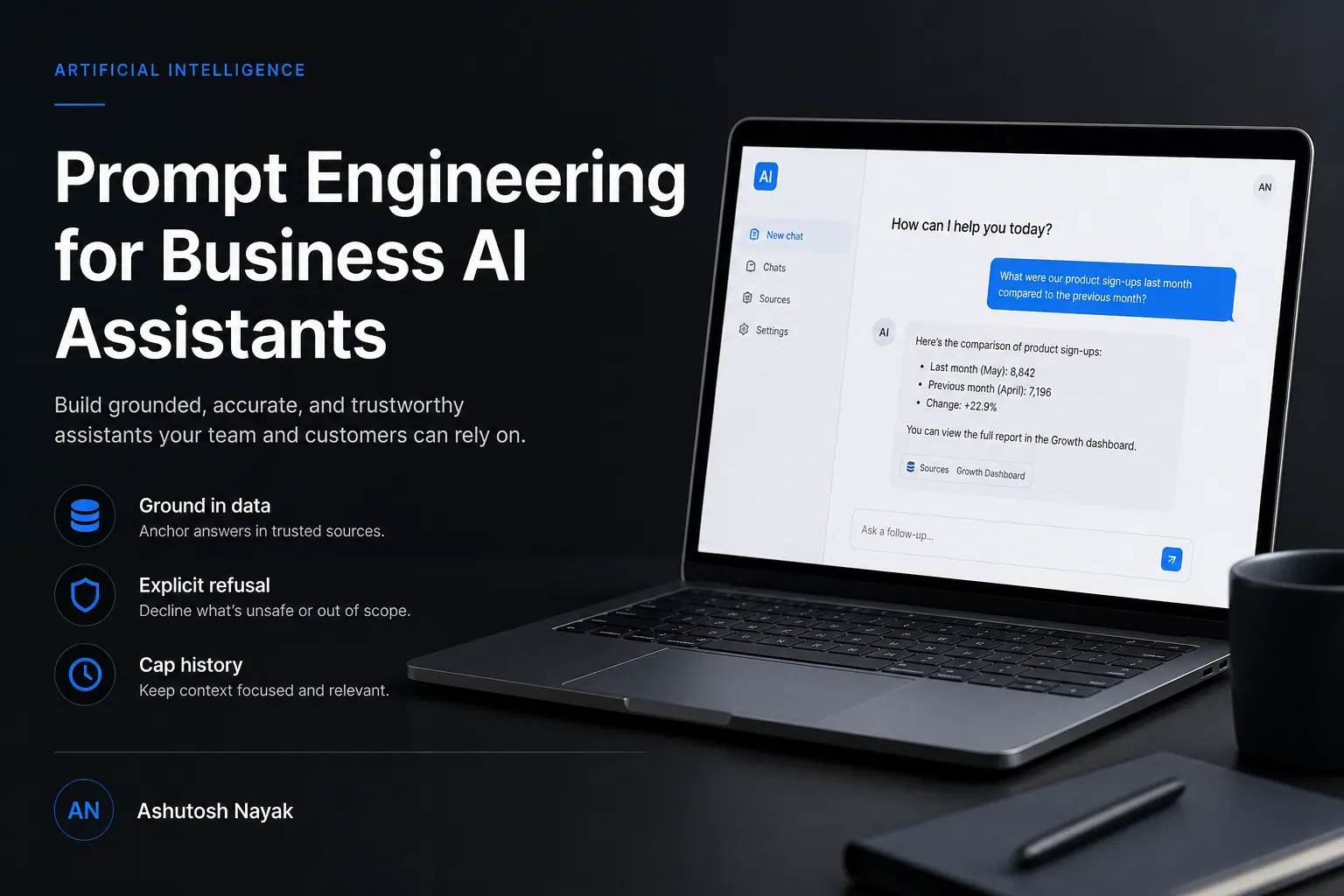
Prompt Engineering for Business AI Assistants
How to design system prompts for LLM assistants that answer from a fixed knowledge base without hallucinating — lessons from building this site's own chatbot.

Fine-tuning LLMs: A Practical Guide for Developers
Learn the essentials of fine-tuning Large Language Models (LLMs) for custom applications. A practical guide for developers.

Fine-Tuning LLMs: Tailoring AI for Your Business Needs
Unlock the power of Large Language Models by understanding the nuances of fine-tuning. Learn how to adapt pre-trained models for specific business tasks and improve accuracy.
Get new articles in your inbox
Occasional writing on AI, ERP and data analytics — no spam, unsubscribe any time.