 Ashutosh Nayak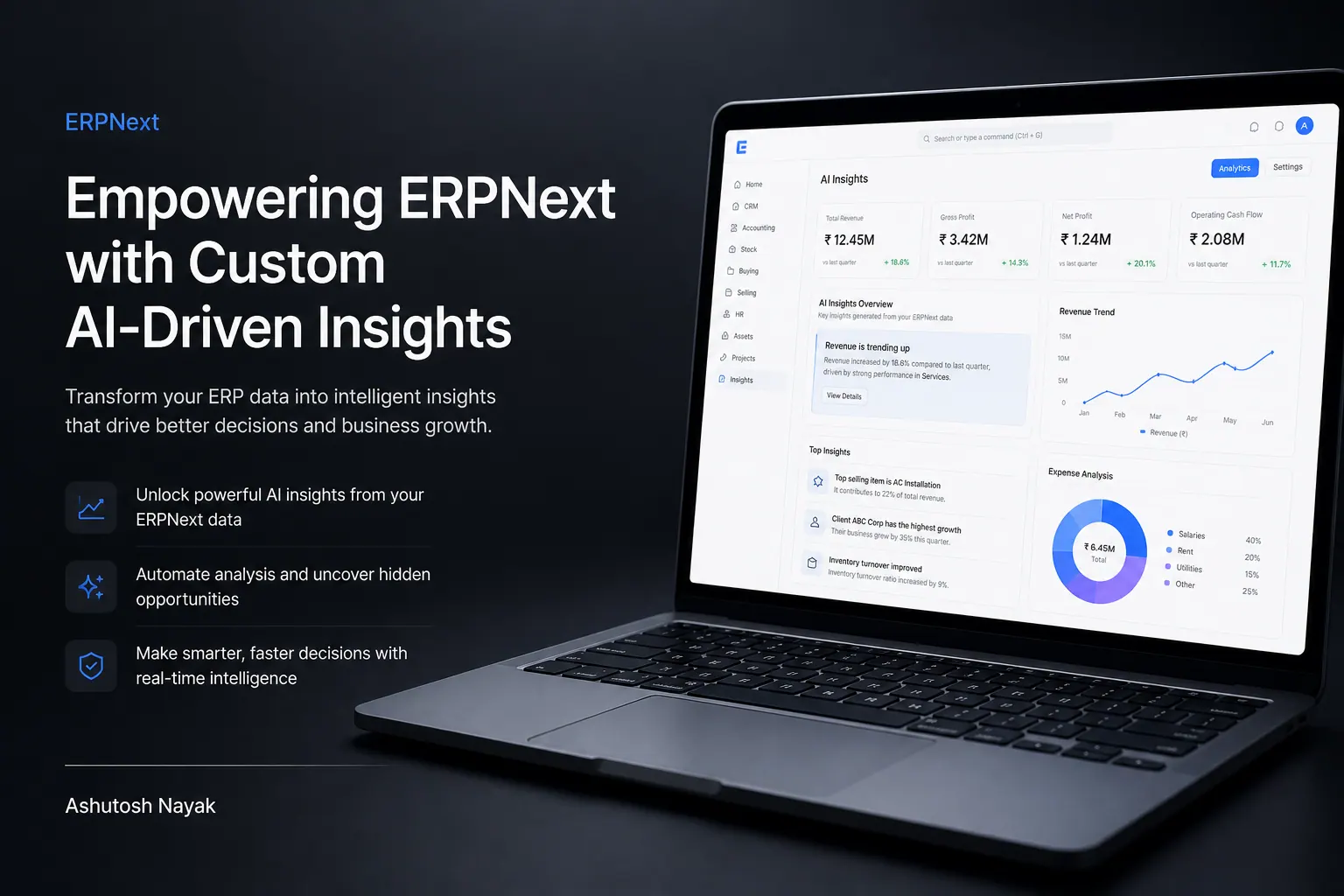
The Unseen Potential: Beyond Standard ERP Features
ERPNext, a robust and flexible open-source ERP system, empowers businesses with a comprehensive suite of tools for managing operations. However, as businesses grow and data volumes explode, the demand for deeper, more proactive insights intensifies. Standard reporting and analytics, while valuable, often fall short in predicting future trends, identifying subtle anomalies, or automating complex decision-making that goes beyond predefined rules. This is where the integration of custom Artificial Intelligence (AI) and Machine Learning (ML) models can truly transform ERPNext from a powerful operational tool into an intelligent business powerhouse.
While ERPNext offers a solid foundation, its true potential for innovation lies in its extensibility. Ashutosh Nayak's expertise bridges the gap between this powerful ERP system and the cutting-edge capabilities of AI and ML, enabling businesses to unlock entirely new levels of efficiency and strategic advantage. This post explores how to conceptualize and implement custom AI-driven insights within your ERPNext instance, moving beyond generic dashboards to create truly predictive and prescriptive functionalities.
Identifying Opportunities for AI Integration
The first step in leveraging AI within ERPNext is to identify specific business challenges or opportunities where data-driven intelligence can make a significant impact. Think beyond simple reporting. Consider areas where:
- Predictive Power is Crucial: Forecasting sales, predicting customer churn, anticipating equipment maintenance needs, or estimating project completion times.
- Pattern Recognition is Key: Identifying fraudulent transactions, detecting quality control issues in manufacturing, or segmenting customers based on complex behavioral patterns.
- Automation of Complex Decisions: Optimizing inventory levels dynamically, recommending optimal pricing strategies, or automating credit risk assessment.
- Uncovering Hidden Relationships: Discovering correlations between marketing campaigns and sales, understanding the drivers of customer satisfaction, or optimizing supply chain logistics.
For example, a manufacturing company might want to predict equipment failures before they occur to minimize downtime. A retail business might aim to predict the demand for specific products to optimize stock levels and reduce overstocking or stockouts. A service-based company could use AI to predict which clients are at risk of churning.
The Technical Backbone: Python, Frappe, and AI Libraries
ERPNext is built on the Frappe framework, which uses Python extensively. This synergy is a massive advantage for integrating custom AI/ML solutions. Python boasts a rich ecosystem of powerful AI and ML libraries, including:
- Scikit-learn: For traditional machine learning algorithms (classification, regression, clustering).
- TensorFlow & PyTorch: For deep learning, neural networks, and complex pattern recognition.
- Pandas & NumPy: For efficient data manipulation and numerical operations, essential for preparing data for ML models.
- SciPy: For scientific and technical computing.
- Statsmodels: For statistical modeling and analysis.
The Frappe framework provides the necessary hooks and APIs to interact with ERPNext's database and business logic. You can leverage Frappe's server-side scripting capabilities (Python) to:
- Extract Data: Query relevant data from ERPNext doctypes (e.g., Sales Orders, Customer Records, Production Logs, Maintenance Schedules).
- Preprocess Data: Clean, transform, and engineer features from the extracted data using Pandas and NumPy.
- Train Models: Load and train your custom AI/ML models using libraries like Scikit-learn or TensorFlow.
- Make Predictions/Generate Insights: Use the trained models to generate predictions or identify insights.
- Integrate Results: Feed these predictions or insights back into ERPNext, either by creating new doctypes, updating existing fields, or triggering custom workflows.
A Practical Example: Predictive Maintenance in ERPNext
Let's consider implementing a predictive maintenance solution for machinery within ERPNext. This scenario leverages data typically stored in ERPNext.
1. Data Extraction and Preparation
- Source Data: Collect data from various ERPNext doctypes:
Machinedoctype: Machine ID, installation date, manufacturer, model.Maintenance Scheduledoctype: Scheduled maintenance dates, type of maintenance.Work Orderdoctype: For completed repairs, parts used, time spent, issues reported.Sensor Readings(if available, potentially integrated from IoT devices): Temperature, vibration, pressure, operating hours.
- Data Wrangling: Use Python (Pandas) to merge these data sources. Clean missing values, standardize formats, and calculate features like 'time since last maintenance', 'average operating temperature', 'number of breakdowns in the last year'.
2. Feature Engineering & Model Selection
- Target Variable: Define what you want to predict. For predictive maintenance, this could be 'time until next failure', 'probability of failure within X days', or a 'failure alert flag'.
- Features: The engineered features from step 1 become your input features.
- Model Choice: For predicting failure probability, a classification model like Logistic Regression, Random Forest, or Gradient Boosting (from Scikit-learn) might be suitable. For predicting 'time until failure', a regression model or survival analysis could be used.
3. Model Training
- Split the prepared data into training and testing sets.
- Train the chosen model on the training data.
- Evaluate the model's performance using metrics relevant to the problem (e.g., accuracy, precision, recall, F1-score for classification; Mean Squared Error for regression).
4. Integration into ERPNext
This is where the Frappe framework shines.
- Custom Doctype: Create a new doctype, e.g.,
Predictive Maintenance Alert, to store the AI-generated insights. This doctype could include fields likeMachine,Predicted Failure Date,Probability Score,Status(e.g., 'Low Risk', 'Medium Risk', 'High Risk'). - Scheduled Job/Server Script: Create a Frappe server script or a scheduled job that runs periodically (e.g., daily).
- This script will execute the data extraction, preprocessing, and prediction pipeline.
- For each machine, it generates a prediction.
- Based on the prediction (e.g., high probability of failure within the next 30 days), it creates a new record in the
Predictive Maintenance Alertdoctype.
- Workflow Automation: Configure ERPNext workflows to trigger actions based on new
Predictive Maintenance Alertrecords:- Automatically create a
Work Orderfor maintenance. - Notify the maintenance manager via email or an internal notification.
- Update the status of the
Machinerecord.
- Automatically create a
5. Visualization and Reporting
- Use ERPNext's built-in reporting tools or create custom reports to visualize the
Predictive Maintenance Alerts. - Develop dashboards showing machines at high risk, upcoming predicted failures, and the effectiveness of the alerts in preventing breakdowns.
Beyond Maintenance: Other AI Applications
This predictive maintenance example is just one illustration. Similar approaches can be applied to:
- Sales Forecasting: Predict future sales based on historical data, seasonality, marketing efforts, and economic indicators.
- Customer Churn Prediction: Identify customers likely to leave and trigger retention campaigns.
- Inventory Optimization: Predict demand to automate reordering and minimize holding costs.
- Credit Risk Assessment: Score potential customers based on historical payment data and external factors.
- Fraud Detection: Flag suspicious transactions in real-time.
Challenges and Best Practices
- Data Quality: AI models are only as good as the data they are trained on. Ensure robust data collection and cleaning processes within ERPNext.
- Model Interpretability: For critical decisions, understanding why a model made a certain prediction is important. Choose models that offer some level of interpretability or use techniques to explain predictions.
- Model Drift: AI models can degrade over time as business conditions change. Implement mechanisms for monitoring model performance and retraining models periodically.
- Scalability: Ensure your integration approach scales with your data volume and processing needs. Consider cloud-based ML platforms for heavy-duty training if necessary.
- Security and Privacy: Handle sensitive business data with utmost care, adhering to all relevant regulations.
Conclusion: The Intelligent ERPNext
Integrating custom AI and ML solutions into ERPNext transforms it from a reactive system of record into a proactive engine for business intelligence and automation. By leveraging Python's extensive AI/ML ecosystem and Frappe's flexible framework, businesses can unlock unprecedented insights, optimize operations, and gain a significant competitive edge. Ashutosh Nayak’s expertise in both ERPNext development and AI/ML empowers organizations to harness this potential, building smarter, more efficient, and future-ready enterprises.
Start by identifying a key business challenge, explore your ERPNext data, and begin experimenting. The journey towards an intelligent ERPNext is an investment that yields substantial returns in efficiency, foresight, and strategic advantage.
Related articles

Mastering ERPNext Reporting: Beyond Standard Reports
Unlock the full potential of ERPNext reporting. Learn advanced techniques and custom solutions for deeper business insights.
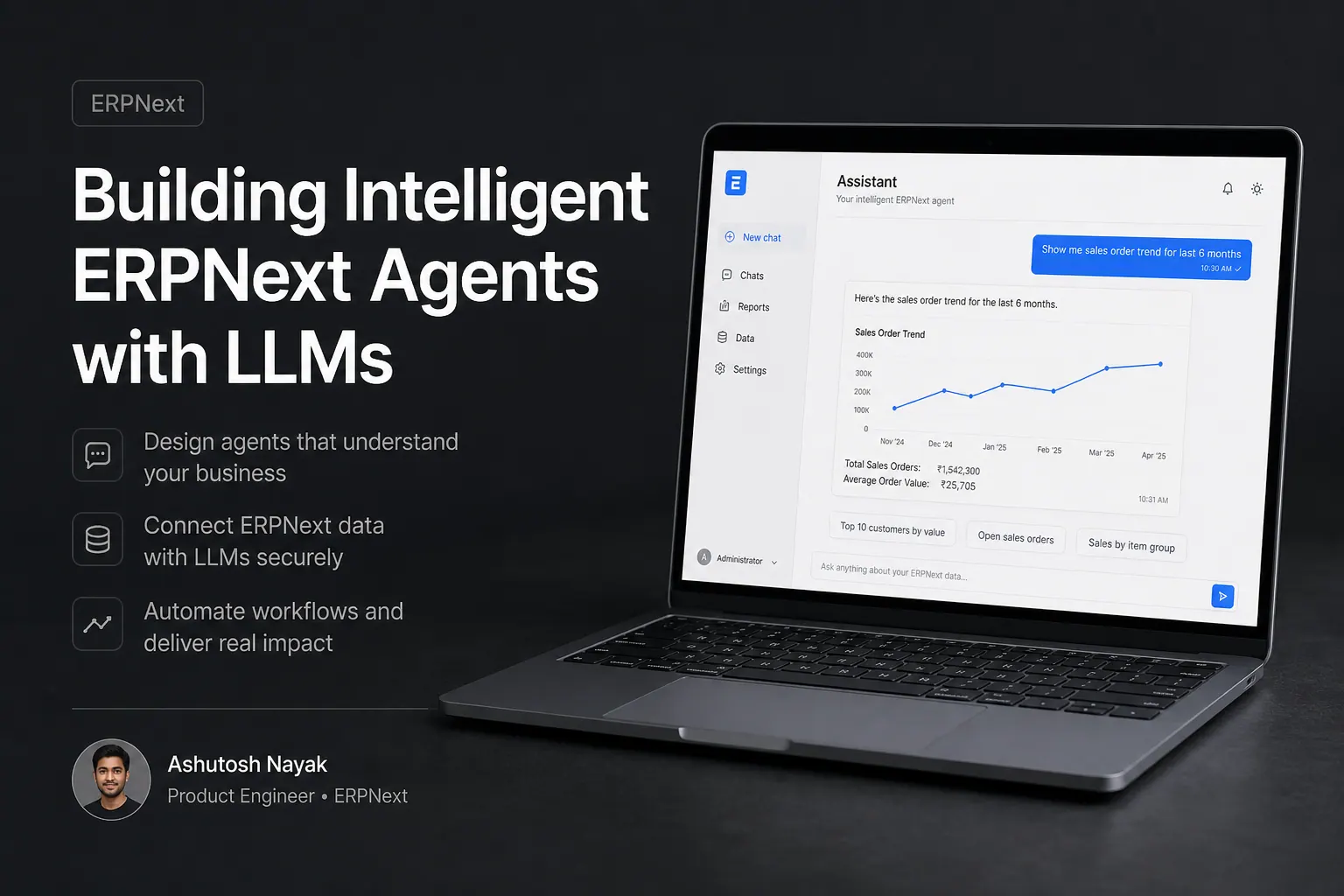
Building Intelligent ERPNext Agents with LLMs
Explore how to integrate Large Language Models (LLMs) with ERPNext to create intelligent agents for automated business processes and enhanced data analysis.

Empowering ERPNext with Python: Advanced Data Manipulation
Unlock the full potential of your ERPNext data. Learn advanced Python techniques for sophisticated data manipulation, reporting, and automation.
Get new articles in your inbox
Occasional writing on AI, ERP and data analytics — no spam, unsubscribe any time.