 Ashutosh Nayak

The Power of Precision: Why Prompt Engineering Matters
Large Language Models (LLMs) like GPT-3, GPT-4, and others have revolutionized what's possible with artificial intelligence. They can generate text, translate languages, write different kinds of creative content, and answer your questions in an informative way. However, the true power of these models isn't just in their existence, but in how effectively we can interact with them. This is where the art and science of prompt engineering come into play.
As AI & ML Engineers, Business Analysts, and Frappe/ERPNext Developers, understanding prompt engineering is no longer a niche skill; it's becoming a foundational requirement for leveraging LLMs effectively. Whether you're building intelligent chatbots, automating content creation, performing complex data analysis, or integrating AI into existing business workflows, the quality of your prompts directly dictates the quality of the output. This article will dive into practical techniques for crafting better prompts, moving beyond simple instructions to elicit more precise, relevant, and useful responses from LLMs.
Understanding Prompt Structure and Elements
A well-crafted prompt is more than just a question. It's a carefully designed instruction set that guides the LLM towards a desired outcome. Let's break down the key elements:
-
Instruction: This is the core command. It tells the LLM what to do. Be clear and concise. Instead of "Write about AI," try "Explain the concept of supervised learning in machine learning, providing a real-world example."
-
Context: Providing background information helps the LLM understand the scenario and constraints. This could include specific domain knowledge, previous conversation history, or the intended audience for the output.
-
Input Data: If the LLM needs to process specific information, include it directly in the prompt. This could be a paragraph of text, a list of items, or even structured data.
-
Output Format: Specify how you want the output to be presented. Do you need a bulleted list, a JSON object, a table, a poem, or a formal report? Explicitly stating the desired format significantly improves consistency.
Key Prompt Engineering Techniques
Let's explore some actionable strategies that can elevate your prompt engineering skills:
1. Zero-Shot Prompting
This is the most basic form, where you ask the LLM to perform a task without providing any examples. It relies entirely on the LLM's pre-trained knowledge. While simple, it's effective for tasks the LLM is highly familiar with.
Example: Translate the following English text to French: 'Hello, how are you?'
2. Few-Shot Prompting
Here, you provide a few examples of the task you want the LLM to perform. This helps the LLM understand the pattern, style, and expected output format. It's particularly useful for tasks that require a specific nuance or structure.
Example: `Input: Apple Sentiment: Positive
Input: Terrible movie Sentiment: Negative
Input: The weather is okay. Sentiment: Neutral
Input: I loved the performance! Sentiment:`
By providing these examples, you guide the LLM to classify the sentiment of the final input correctly.
3. Chain-of-Thought (CoT) Prompting
This is a powerful technique for complex reasoning tasks. Instead of expecting a direct answer, you encourage the LLM to explain its thought process step-by-step. This not only leads to more accurate answers but also makes the LLM's reasoning transparent.
Example: Q: Roger has 5 tennis balls. He buys 2 more cans of tennis balls. Each can has 3 tennis balls. How many tennis balls does he have now? A: Roger started with 5 balls. 2 cans of 3 balls each is 2 * 3 = 6 balls. So in total he has 5 + 6 = 11 balls. The answer is 11.
When prompting, you can encourage this by adding phrases like "Let's think step by step" or by providing few-shot examples that include the reasoning.
4. Role-Playing Prompts
Assigning a persona to the LLM can significantly influence its tone, style, and the type of information it prioritizes. This is invaluable when you need the output tailored for a specific audience or purpose.
Example: Act as a senior software architect. Explain the trade-offs between microservices and monolithic architectures to a junior developer, focusing on maintainability and scalability.
5. Specifying Output Constraints and Formats
As mentioned earlier, being explicit about the desired output format is crucial. This can range from simple formatting requests to complex data structures.
Example: List the top 5 programming languages by market share. Provide the output as a JSON object with keys 'language' and 'market_share'.
Example: Summarize the following article into three bullet points, each no more than 20 words.
6. Iterative Refinement
Prompt engineering is rarely a one-shot process. It often involves iteration. Start with a prompt, evaluate the output, and then refine the prompt based on the results. Identify what went wrong and adjust your instructions, context, or examples accordingly. Did the LLM misunderstand a term? Add a definition. Was the output too verbose? Add a length constraint.
Practical Applications for Different Roles
For AI & ML Engineers:
- Model Evaluation: Use prompts to test LLM capabilities on specific tasks (e.g., "Given this dataset description, what are potential preprocessing steps?").
- Code Generation: Prompt LLMs to generate boilerplate code, unit tests, or even suggest algorithms based on problem descriptions.
- Data Augmentation: Generate synthetic data variations for training smaller models.
For Business Analysts:
- Requirements Gathering: Prompt LLMs to ask clarifying questions about user stories or to summarize meeting notes into actionable items.
- Market Research: "Summarize the key competitive advantages of company X based on these articles" or "Identify common customer pain points from these reviews."
- Report Generation: "Draft an executive summary for a project status report, highlighting key risks and mitigation strategies."
For Frappe/ERPNext Developers:
- DocType Design: "Suggest relevant fields and their data types for a 'Project Management' DocType in ERPNext, considering typical project lifecycle stages."
- Workflow Automation Ideas: "Given the workflow of processing a sales order, suggest areas where an LLM agent could automate manual steps."
- Custom Scripting Assistance: "Write a Python script for Frappe that sends an email notification when a Sales Order's status changes to 'Completed'."
Common Pitfalls and How to Avoid Them
- Ambiguity: Vague instructions lead to vague results. Be as specific as possible.
- Over-reliance on Zero-Shot: For complex or nuanced tasks, few-shot or CoT prompting is usually necessary.
- Lack of Context: The LLM doesn't know your specific business domain unless you tell it. Provide relevant context.
- Unrealistic Expectations: LLMs are powerful but not infallible. They can hallucinate or make errors. Always review and validate critical outputs.
- Ignoring Output Format: Don't expect structured data from an unstructured prompt. Clearly define the desired output.
The Future of Prompt Engineering
As LLMs become more sophisticated, the role of prompt engineering will continue to evolve. We'll likely see more advanced techniques emerge, potentially involving dynamic prompt generation, multi-agent systems coordinating through prompts, and even AI models assisting in the creation of prompts. For professionals in the AI, ML, and software development space, mastering prompt engineering is an investment that will pay dividends as these technologies become even more deeply integrated into our tools and workflows.
By understanding the principles and actively practicing these techniques, you can move from simply using LLMs to truly harnessing their power to build more intelligent, efficient, and innovative solutions. Start experimenting today, and watch your AI application development reach new heights.
Related articles

Demystifying Prompt Engineering for LLMs
Unlock the potential of Large Language Models. Learn prompt engineering techniques to get the best results for your AI applications.

Fine-tuning LLMs: Tailoring AI for Your Business Needs
Learn how fine-tuning large language models (LLMs) can customize AI for specific business tasks, improving accuracy and relevance. A practical guide.
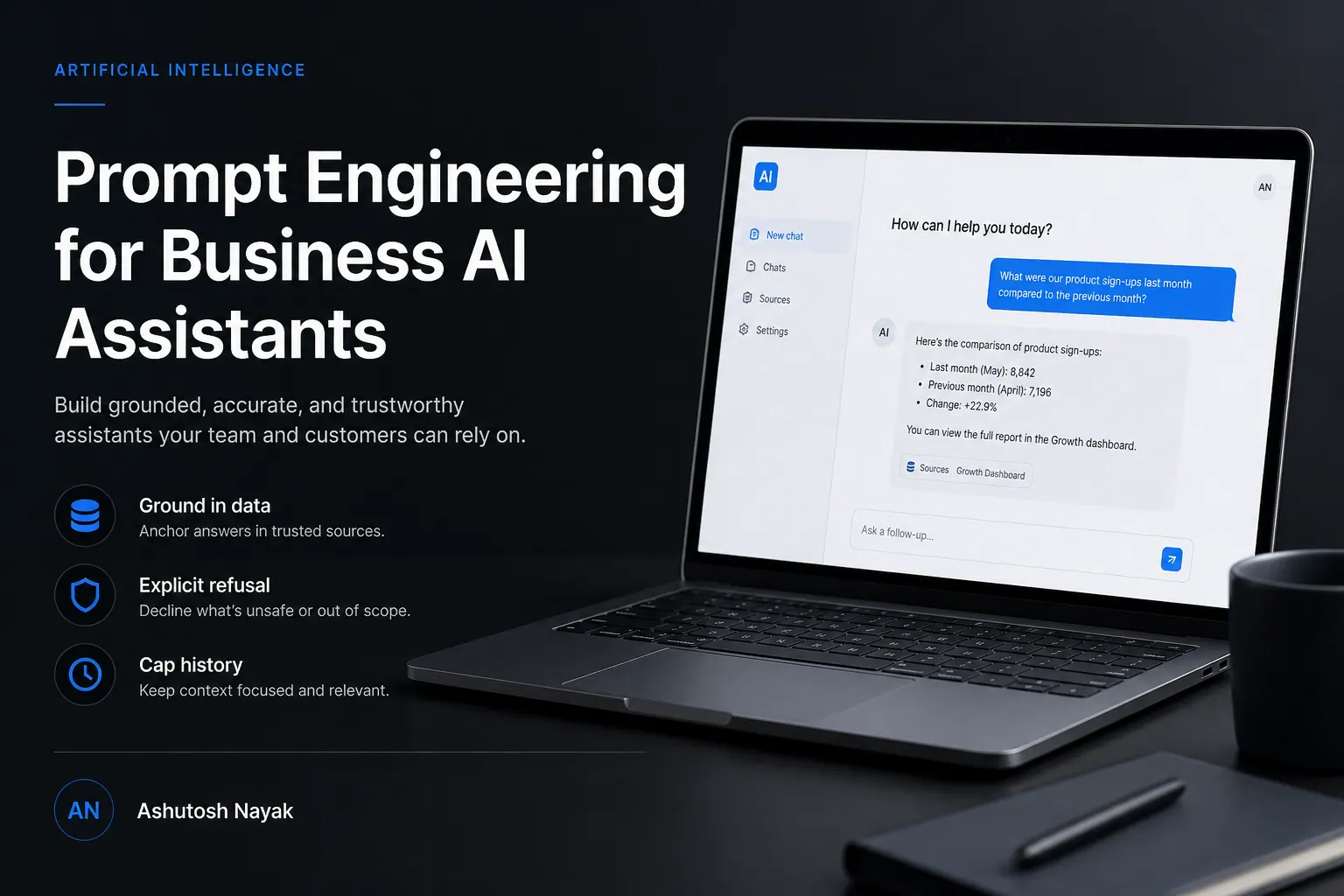
Prompt Engineering for Business AI Assistants
How to design system prompts for LLM assistants that answer from a fixed knowledge base without hallucinating — lessons from building this site's own chatbot.
Get new articles in your inbox
Occasional writing on AI, ERP and data analytics — no spam, unsubscribe any time.