 Ashutosh Nayak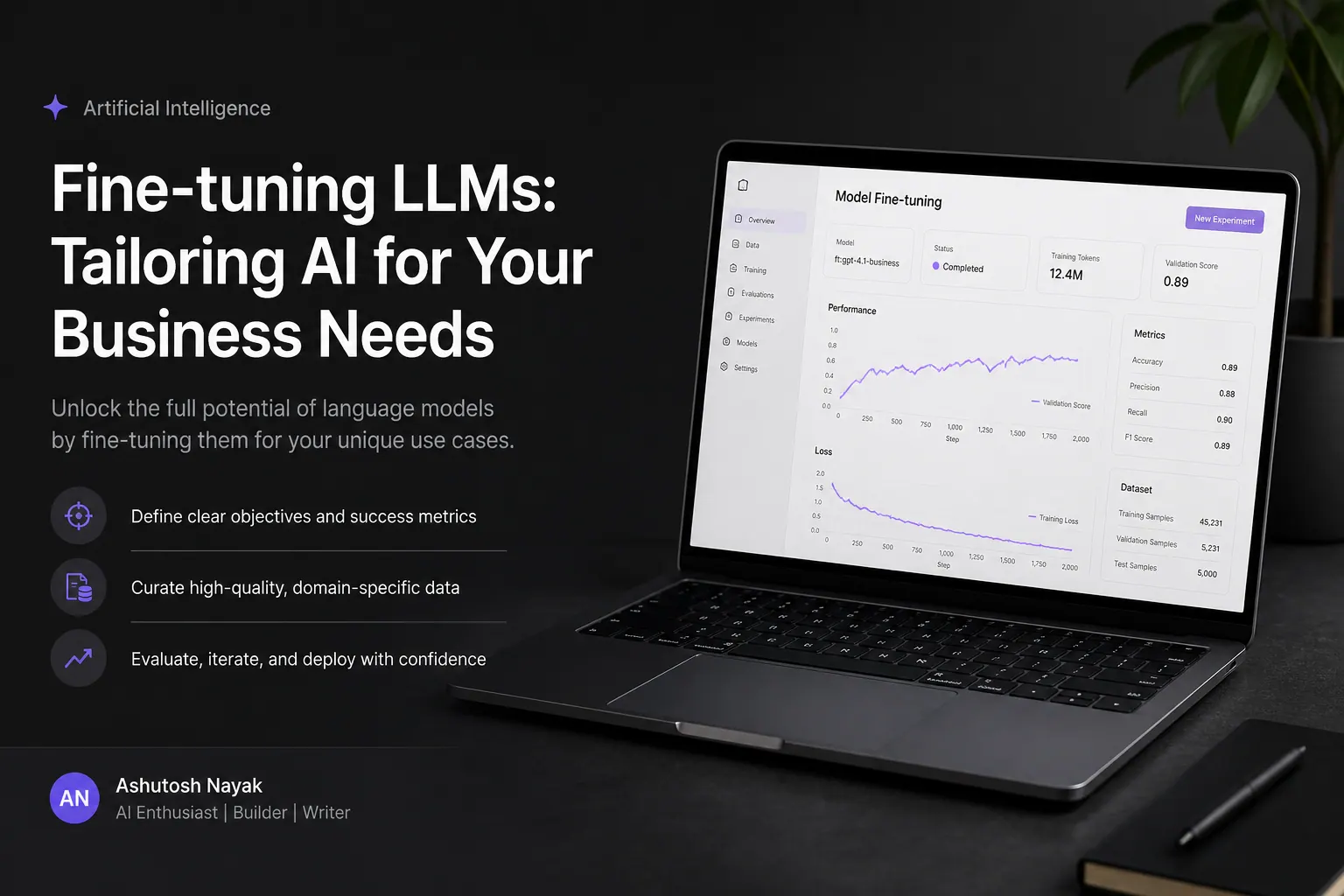
The Power of Customization in Large Language Models
Large Language Models (LLMs) like GPT-3, BERT, and others have revolutionized how we interact with and process information. Their ability to understand and generate human-like text is astounding, opening up a plethora of possibilities for businesses. However, while these general-purpose LLMs are incredibly powerful, they often lack the nuanced understanding and specific domain knowledge required for highly specialized business applications. This is where the concept of fine-tuning comes into play.
Fine-tuning an LLM involves taking a pre-trained model and further training it on a smaller, task-specific dataset. Think of it like teaching a brilliant generalist student a specific trade. The student already possesses a vast amount of knowledge; fine-tuning provides them with the specialized skills and vocabulary needed to excel in a particular profession. For businesses, this means transforming a generic AI tool into a highly effective, tailored solution that understands your industry jargon, your products, your customers, and your unique processes.
Why Fine-Tune? The Business Imperative
Generic LLMs are trained on massive, diverse datasets from the internet. While this makes them versatile, it also means they might not perform optimally when faced with tasks that require deep understanding of a particular niche. Consider these scenarios:
- Customer Support: A general LLM might provide helpful answers, but a fine-tuned model can understand your company's specific product catalog, return policies, and common customer issues, leading to faster, more accurate, and more empathetic responses.
- Legal Document Analysis: A pre-trained LLM can identify legal terms, but a fine-tuned model, trained on your company's specific legal documents and contracts, can accurately summarize clauses, identify risks, and flag inconsistencies relevant to your business.
- Medical Research: A generic model can process medical literature, but a fine-tuned model trained on specialized medical journals and patient records can assist researchers in identifying patterns, summarizing complex studies, and even suggesting hypotheses.
- Technical Documentation: Generating accurate and consistent technical manuals requires specific terminology and understanding of engineering principles. A fine-tuned LLM can ensure that generated documentation adheres to strict internal standards.
The benefits of fine-tuning are clear: improved accuracy, enhanced relevance, reduced hallucinations (as the model learns from curated, factual data), and the ability to perform highly specialized tasks that a general model would struggle with. It allows businesses to leverage the power of LLMs without sacrificing the precision and context crucial for their operations.
The Fine-Tuning Process: A Technical Overview
While the concept is straightforward, the practical implementation of fine-tuning involves several key steps:
-
Dataset Preparation: This is arguably the most critical step. You need to curate a dataset that is representative of the task you want the LLM to perform. This dataset should consist of input-output pairs. For example, if you're fine-tuning for customer support, your dataset might include customer questions (input) and the ideal, accurate answers (output) from your support team. The quality and relevance of this data directly impact the performance of the fine-tuned model.
- Data Quality: Ensure the data is clean, accurate, and free from bias. Inaccurate or biased data will be learned by the model, leading to flawed outputs.
- Data Quantity: While fine-tuning requires less data than pre-training, you still need a sufficient amount. The exact quantity depends on the complexity of the task and the desired level of performance, but generally, hundreds or thousands of high-quality examples are recommended.
- Data Format: The data needs to be formatted correctly, usually as pairs of prompts and completions, or in specific structures required by the fine-tuning API or framework.
-
Choosing a Pre-trained Model: Select a base LLM that is suitable for your task. Models vary in their architecture, size, and the data they were originally trained on, which can influence their suitability for different downstream tasks. For instance, some models are better suited for conversational AI, while others excel at text summarization or code generation.
-
The Fine-Tuning Execution: This involves using specific tools and platforms that support fine-tuning. Many LLM providers (like OpenAI, Google, Anthropic) offer APIs or services that allow users to upload their datasets and initiate the fine-tuning process. This typically involves configuring hyperparameters such as learning rate, batch size, and the number of training epochs.
- Hardware Requirements: Fine-tuning can be computationally intensive, often requiring significant GPU resources. Cloud platforms are commonly used to access this computational power.
- Cost Considerations: Fine-tuning incurs costs, both for computation and for the potential use of proprietary models and APIs. It's essential to factor these into your budget.
-
Evaluation and Iteration: After fine-tuning, it's crucial to evaluate the model's performance on a separate test dataset (data that was not used during training). Metrics will vary depending on the task (e.g., accuracy, F1-score for classification, BLEU for translation, ROUGE for summarization). Based on the evaluation, you may need to iterate on the process by adjusting the dataset, hyperparameters, or even choosing a different base model.
Practical Applications and Case Studies
Let's consider a concrete example: an e-commerce company wants to improve its product recommendation engine. A general LLM could be used to understand product descriptions, but to make truly personalized recommendations, it needs to understand user preferences, past purchase history, and even stylistic nuances.
By fine-tuning an LLM on a dataset comprising anonymized customer interaction logs (search queries, viewed products, items added to cart, purchase history) and product metadata, the company can create a model that understands:
- User Intent: What is the customer really looking for?
- Product Relationships: How do different products relate to each other in terms of style, function, or complementarity?
- Personalized Context: What specific preferences has this user expressed or demonstrated?
The fine-tuned model can then generate highly relevant product suggestions, leading to increased customer engagement and sales. Another common application is in content generation. For instance, a marketing team can fine-tune an LLM on their existing successful marketing copy to generate new ad creatives, blog post outlines, or social media updates that align with their brand voice and messaging strategy.
Challenges and Best Practices
While fine-tuning offers immense potential, it's not without its challenges:
- Data Scarcity: For highly niche domains, gathering a sufficient quantity of high-quality training data can be difficult.
- Overfitting: The model might become too specialized on the training data and perform poorly on slightly different inputs. Careful validation and regularization techniques are needed.
- Computational Costs: As mentioned, fine-tuning requires substantial computing resources, which can be a barrier for smaller organizations.
- Bias Amplification: If the fine-tuning data contains biases, the model will likely amplify them.
To mitigate these challenges, it's essential to follow best practices:
- Start Small: Begin with a well-defined, narrow task and a high-quality dataset.
- Iterate: Fine-tuning is often an iterative process. Be prepared to experiment and refine your approach.
- Focus on Data Quality: Prioritize cleaning and curating your dataset over sheer volume.
- Monitor Performance: Continuously evaluate the model in real-world scenarios and retrain as needed.
- Consider Parameter-Efficient Fine-Tuning (PEFT): Techniques like LoRA (Low-Rank Adaptation) allow for fine-tuning with significantly fewer computational resources and less memory, making it more accessible.
The Future of Tailored AI
As LLMs continue to evolve, fine-tuning will remain a cornerstone of their practical application in business. It bridges the gap between the general intelligence of pre-trained models and the specific demands of real-world business problems. By investing in carefully prepared data and strategic fine-tuning, organizations can unlock unprecedented levels of efficiency, personalization, and innovation. It's no longer about just using AI; it's about shaping AI to work precisely for your business needs. This tailored approach is not just a competitive advantage; it's becoming a necessity in the rapidly advancing AI landscape.
Related articles

Fine-tuning LLMs: A Practical Guide for Developers
Learn the essentials of fine-tuning Large Language Models (LLMs) for custom applications. A practical guide for developers.

Demystifying Prompt Engineering for LLMs
Unlock the potential of Large Language Models. Learn prompt engineering techniques to get the best results for your AI applications.

Beyond the Hype: Practical LLM Applications for SMEs
Discover real-world uses of Large Language Models (LLMs) for small and medium-sized enterprises, moving past the hype to actionable insights.
Get new articles in your inbox
Occasional writing on AI, ERP and data analytics — no spam, unsubscribe any time.