 Ashutosh Nayak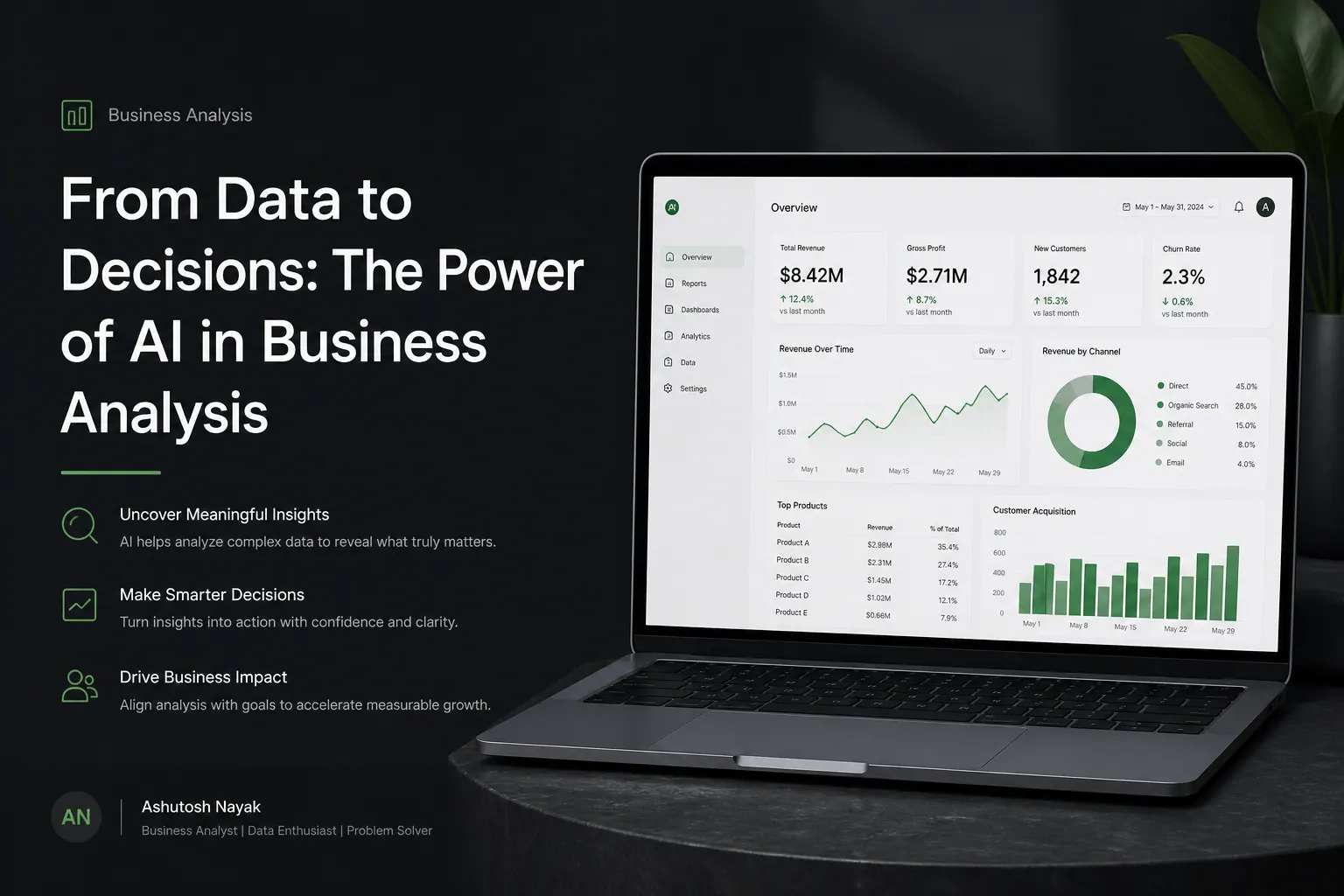
The Evolution of Business Analysis: From Spreadsheets to Sentient Insights
For decades, business analysis has been the bedrock of strategic decision-making. It involves understanding the needs of stakeholders and identifying business problems and opportunities to propose solutions. Traditionally, this meant painstaking data collection, manual analysis using spreadsheets, and crafting reports that, while valuable, often lagged behind the real-time pulse of the business. The insights derived were often constrained by human analytical capacity and the sheer volume of data that could be practically processed.
However, the advent of Artificial Intelligence (AI) and Machine Learning (ML) has ushered in a new era. AI is no longer a futuristic concept confined to research labs; it's a potent tool actively reshaping how businesses operate and how analysts derive actionable intelligence. This transformation isn't just about speed; it's about depth, accuracy, and the ability to uncover patterns and correlations that would remain hidden to human eyes.
Understanding AI's Role in Modern Business Analysis
At its core, AI, particularly machine learning, excels at processing vast datasets, identifying complex patterns, and making predictions. For business analysts, this translates into a powerful toolkit that augments their capabilities across several key areas:
1. Enhanced Data Processing and Preparation
One of the most time-consuming aspects of business analysis is data cleaning and preparation. AI-powered tools can automate many of these tedious tasks. Algorithms can identify anomalies, handle missing values, standardize formats, and even infer relationships between disparate data sources far more efficiently than manual methods. This frees up analysts to focus on the higher-value tasks of interpretation and strategic recommendation.
2. Predictive Analytics for Proactive Strategies
Instead of merely reporting on past performance, AI enables analysts to predict future outcomes. Machine learning models can analyze historical data to forecast sales trends, customer behavior, market shifts, and operational efficiencies. For instance, predictive models can identify customers at high risk of churn, allowing marketing and sales teams to intervene proactively. Similarly, forecasting demand more accurately can optimize inventory management and supply chain operations, reducing waste and improving profitability.
3. Deeper Customer Understanding
AI, especially through Natural Language Processing (NLP), can analyze unstructured data from customer feedback, social media, and support interactions. This allows businesses to gain nuanced insights into customer sentiment, identify pain points, and understand unmet needs. Sentiment analysis can gauge the overall mood surrounding a product or brand, while topic modeling can reveal recurring themes in customer complaints or praise. This granular understanding is invaluable for product development, marketing campaigns, and customer service improvements.
4. Automating Routine Analysis and Reporting
Many analytical tasks are repetitive. AI can automate the generation of standard reports, dashboards, and key performance indicator (KPI) summaries. This doesn't eliminate the analyst's role but rather elevates it. Instead of spending hours compiling data, analysts can focus on interpreting the automated outputs, investigating anomalies, and developing strategic recommendations based on these AI-generated insights.
5. Fraud Detection and Risk Management
In financial services and e-commerce, AI is a game-changer for fraud detection. ML algorithms can identify unusual transaction patterns in real-time, flagging suspicious activities that might indicate fraud. This proactive approach minimizes financial losses and protects customers. Beyond fraud, AI can analyze risk factors in credit scoring, insurance underwriting, and operational processes, leading to more informed risk management decisions.
Practical Applications Across Industries
The impact of AI in business analysis is far-reaching:
- Retail: Predicting customer purchasing behavior, optimizing pricing strategies, personalizing marketing offers, and managing inventory.
- Finance: Algorithmic trading, credit risk assessment, fraud detection, and personalized financial advice.
- Healthcare: Diagnosing diseases, predicting patient readmission rates, optimizing hospital resource allocation, and personalizing treatment plans.
- Manufacturing: Predictive maintenance for machinery, optimizing production schedules, quality control, and supply chain optimization.
- Marketing: Customer segmentation, campaign effectiveness analysis, personalized advertising, and sentiment analysis of brand perception.
Implementing AI in Your Business Analysis Workflow
Integrating AI into business analysis doesn't require a complete overhaul overnight. It can be a phased approach:
- Identify Key Pain Points: Where are the biggest bottlenecks or missed opportunities in your current analysis process? Start with areas where AI can offer the most immediate value, such as data cleaning or basic forecasting.
- Leverage Existing Tools: Many modern business intelligence (BI) platforms and ERP systems (like ERPNext) are incorporating AI/ML capabilities. Explore these built-in features before investing in standalone solutions.
- Focus on Data Quality: AI models are only as good as the data they are trained on. Invest in data governance and ensure your data is accurate, consistent, and accessible.
- Develop or Acquire Talent: Your team needs the skills to leverage AI effectively. This might involve training existing analysts in data science principles or hiring specialized talent.
- Start Small and Iterate: Begin with pilot projects. Prove the value of AI in a specific area, learn from the experience, and then scale up.
The Future of Business Analysis: A Synergistic Partnership
The future of business analysis lies not in AI replacing humans, but in a synergistic partnership. AI will handle the heavy lifting of data processing, pattern recognition, and prediction, while human analysts will provide the critical thinking, domain expertise, ethical oversight, and strategic context. Analysts will become orchestrators of AI tools, translating complex AI outputs into clear, actionable business strategies.
As AI continues to evolve, we can expect even more sophisticated applications, including more advanced agentic AI systems that can independently perform analytical tasks and even propose solutions. The role of the business analyst will become more strategic, more focused on human-AI collaboration, and more crucial than ever in navigating the complexities of the modern business landscape. Embracing AI is not just an option; it's a necessity for any organization aiming to stay competitive and make truly informed decisions.
Related articles

Bridging the Gap: AI-Powered Business Analysis with ERPNext
Discover how AI can transform ERPNext data into actionable business intelligence, bridging the gap between raw data and strategic decisions.

Bridging Business Gaps with LLMs: Beyond Code
Discover how Large Language Models can transform business analysis, streamlining workflows and uncovering insights beyond traditional methods.
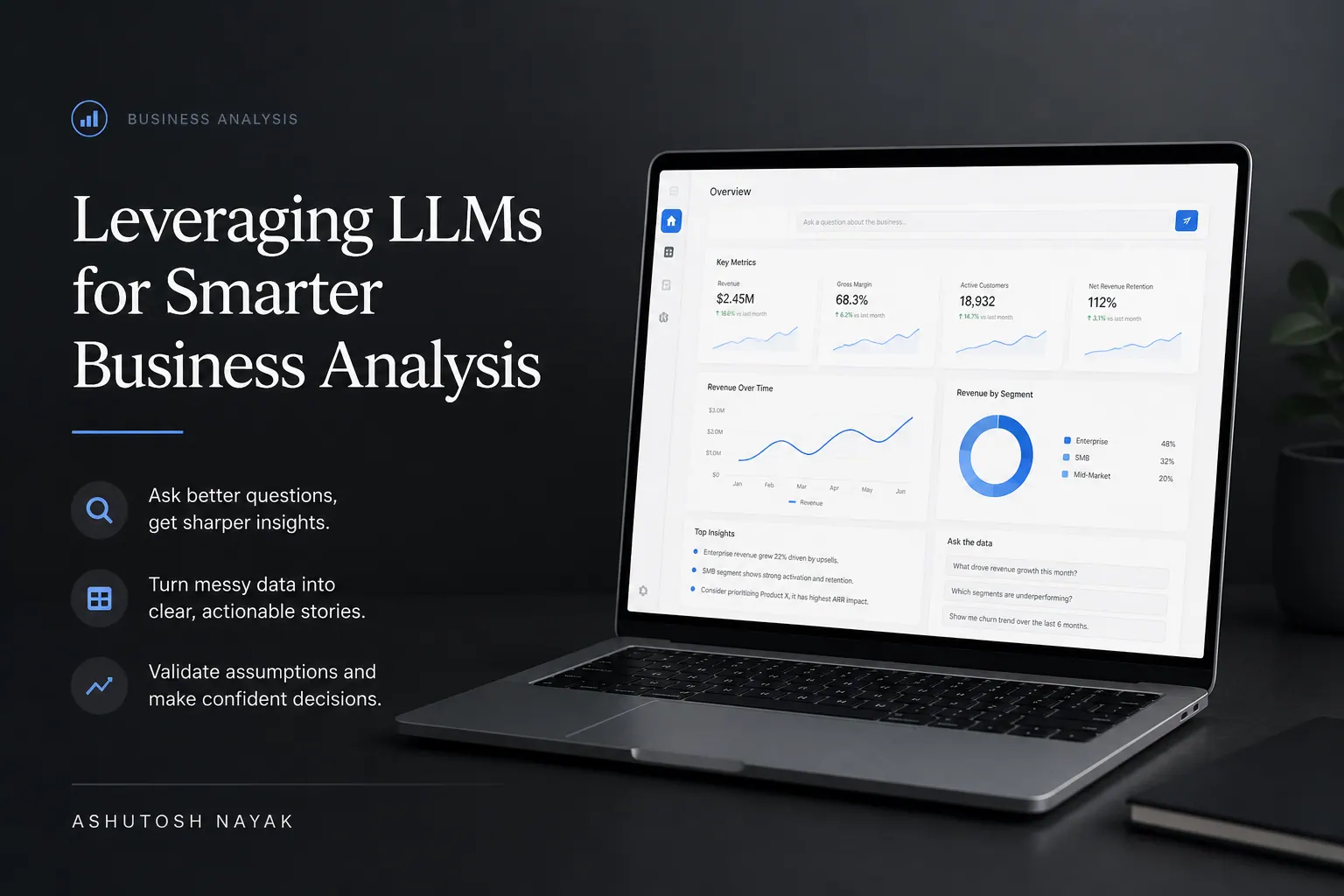
Leveraging LLMs for Smarter Business Analysis
Discover how Large Language Models (LLMs) can revolutionize your business analysis, from data interpretation to strategic decision-making. Explore practical applications and future potential.
Get new articles in your inbox
Occasional writing on AI, ERP and data analytics — no spam, unsubscribe any time.