 Ashutosh Nayak
Introduction: The Data Deluge in Modern Business
In today's hyper-connected business landscape, Enterprise Resource Planning (ERP) systems like ERPNext have become the central nervous system of operations. They diligently collect vast amounts of data across sales, inventory, finance, human resources, and more. However, raw data, no matter how meticulously gathered, is not inherently insightful. The true value lies in transforming this data deluge into actionable intelligence that drives strategic decision-making and operational efficiency. This is where the power of Artificial Intelligence (AI) meets the robust framework of ERPNext, creating a potent synergy for modern businesses.
As an AI & ML Engineer and ERPNext Developer, I've seen firsthand the immense potential that lies dormant within ERP systems. While ERPNext offers powerful reporting and analytics features, integrating AI and Machine Learning (ML) can elevate this capability to an entirely new level. This post explores how we can bridge the gap between the operational data within ERPNext and the strategic insights powered by AI, moving beyond traditional business analysis to a more predictive, proactive, and intelligent approach.
The Limitations of Traditional ERP Analytics
ERP systems, including ERPNext, are designed for transactional processing and reporting. They excel at providing snapshots of current states and historical trends. Standard reports can tell you what happened, how much you sold last quarter, or what your current inventory levels are. While essential for day-to-day management, these reports often fall short when it comes to answering the critical 'why' and 'what if' questions that are vital for strategic growth.
Key limitations include:
- Descriptive, not Predictive: Most standard reports are descriptive, summarizing past events. They rarely offer insights into future outcomes.
- Manual Correlation: Identifying complex relationships and correlations between different data points often requires significant manual effort from analysts.
- Limited Scope: Standard reports are typically pre-defined and may not cover all the nuanced analytical needs of a dynamic business.
- Lagging Indicators: Business intelligence derived from static reports can often be based on lagging indicators, meaning by the time you identify a problem, it may have already had a significant impact.
These limitations create a gap between the wealth of data available and the depth of actionable insight required for competitive advantage.
AI and ML: Unlocking Deeper Insights from ERPNext Data
Artificial Intelligence and Machine Learning offer a transformative approach to analyzing ERP data. Instead of just describing what happened, AI/ML models can predict future trends, identify hidden patterns, and even automate complex decision-making processes. By applying AI/ML techniques to ERPNext's rich dataset, we can unlock a new era of business intelligence.
Consider the following areas where AI can make a significant impact:
1. Predictive Sales Forecasting
Instead of relying on historical averages, ML models can analyze a multitude of factors within ERPNext – such as past sales data, customer demographics, marketing campaign impacts, seasonality, and even external economic indicators – to generate highly accurate sales forecasts. This allows for better inventory management, resource allocation, and financial planning.
2. Customer Churn Prediction
Understanding why customers leave is crucial. ML algorithms can identify patterns in customer behavior within ERPNext (e.g., decreased engagement, reduced purchase frequency, support ticket history) that signal an increased risk of churn. This enables proactive intervention, allowing sales and customer success teams to engage at-risk customers before they churn.
3. Inventory Optimization and Demand Planning
AI can go beyond simple reorder points. By analyzing sales patterns, lead times, supplier reliability, and seasonality, ML models can predict demand with greater accuracy, leading to optimized inventory levels. This minimizes overstocking costs while preventing stockouts, ensuring customer satisfaction and maximizing profit.
4. Fraud Detection and Anomaly Identification
Unusual transactions or patterns in financial data can be flagged by AI models in real-time. This helps in early detection of potential fraud, errors, or operational inefficiencies that might otherwise go unnoticed in standard reports.
5. Personalized Marketing and Sales Recommendations
By analyzing customer purchase history, browsing behavior (if integrated), and demographic data within ERPNext, AI can power personalized product recommendations and targeted marketing campaigns, leading to higher conversion rates and improved customer loyalty.
Practical Steps: Integrating AI with ERPNext
Integrating AI/ML capabilities with ERPNext is not an insurmountable task. It typically involves a combination of data extraction, processing, model development, and integration.
Step 1: Data Extraction and Preparation
ERPNext's database, typically MySQL or PostgreSQL, is the primary source of data. We can extract relevant data using SQL queries or through ERPNext's API. This data then needs to be cleaned, transformed, and formatted appropriately for ML model training. This might involve handling missing values, standardizing formats, and feature engineering – creating new variables from existing data that can improve model performance.
Step 2: Choosing the Right AI/ML Tools and Techniques
Python is the de facto standard for AI/ML development, with powerful libraries like:
- Pandas: For data manipulation and analysis.
- NumPy: For numerical operations.
- Scikit-learn: For a wide range of ML algorithms (classification, regression, clustering).
- TensorFlow/PyTorch: For deep learning applications.
- XGBoost/LightGBM: For high-performance gradient boosting.
The choice of algorithm depends on the specific business problem. For sales forecasting, time-series models or regression algorithms might be suitable. For churn prediction, classification algorithms are often used.
Step 3: Model Development and Training
This involves splitting the prepared data into training and testing sets, selecting an appropriate ML model, training it on the training data, and evaluating its performance on the testing data using relevant metrics (e.g., accuracy, precision, recall, RMSE).
Step 4: Integration and Deployment
Once a satisfactory model is developed, it needs to be integrated back into the business workflow. This can be achieved in several ways:
- Scheduled Batch Predictions: Run the model periodically (e.g., daily, weekly) to generate predictions and store them back in ERPNext (e.g., in custom fields or custom doctypes) or in a separate data warehouse. These predictions can then be viewed through ERPNext's UI or reports.
- API Integration: Develop a web service (e.g., using Flask or FastAPI) that hosts the ML model. ERPNext can then call this API in real-time or near real-time to get predictions. This is particularly useful for applications requiring immediate insights, like fraud detection.
- Frappe/ERPNext Customization: Develop custom Frappe apps or extend existing doctypes to incorporate ML model outputs directly into the user interface. For example, displaying a 'churn probability score' directly on the Customer doctype.
Building a Culture of Data-Driven Decision Making
Implementing AI/ML solutions is not just a technical endeavor; it's also about fostering a culture that embraces data-driven decision-making. This requires:
- Executive Buy-in: Leadership support is crucial for allocating resources and championing the initiative.
- Cross-functional Collaboration: Business analysts, ERP developers, and data scientists must work together to define problems, understand data, and interpret results.
- Continuous Learning and Adaptation: The business environment is constantly changing, so AI models need to be monitored, retrained, and updated regularly.
- Clear Communication: The insights generated by AI must be communicated effectively to stakeholders in a way that is easy to understand and act upon.
Conclusion: The Future is Intelligent
ERPNext is a powerful platform for managing business operations. By integrating AI and ML capabilities, we can transform the data within ERPNext from a passive record into an active driver of intelligent decisions. The journey from raw data to predictive insights is more accessible than ever, enabling businesses to anticipate market changes, optimize resource allocation, enhance customer relationships, and ultimately, achieve sustainable growth. As AI continues to evolve, its role in business analysis, particularly within integrated systems like ERPNext, will only become more critical. Embracing this evolution is not just an option; it's a necessity for staying competitive in the intelligent enterprise of tomorrow.
Related articles
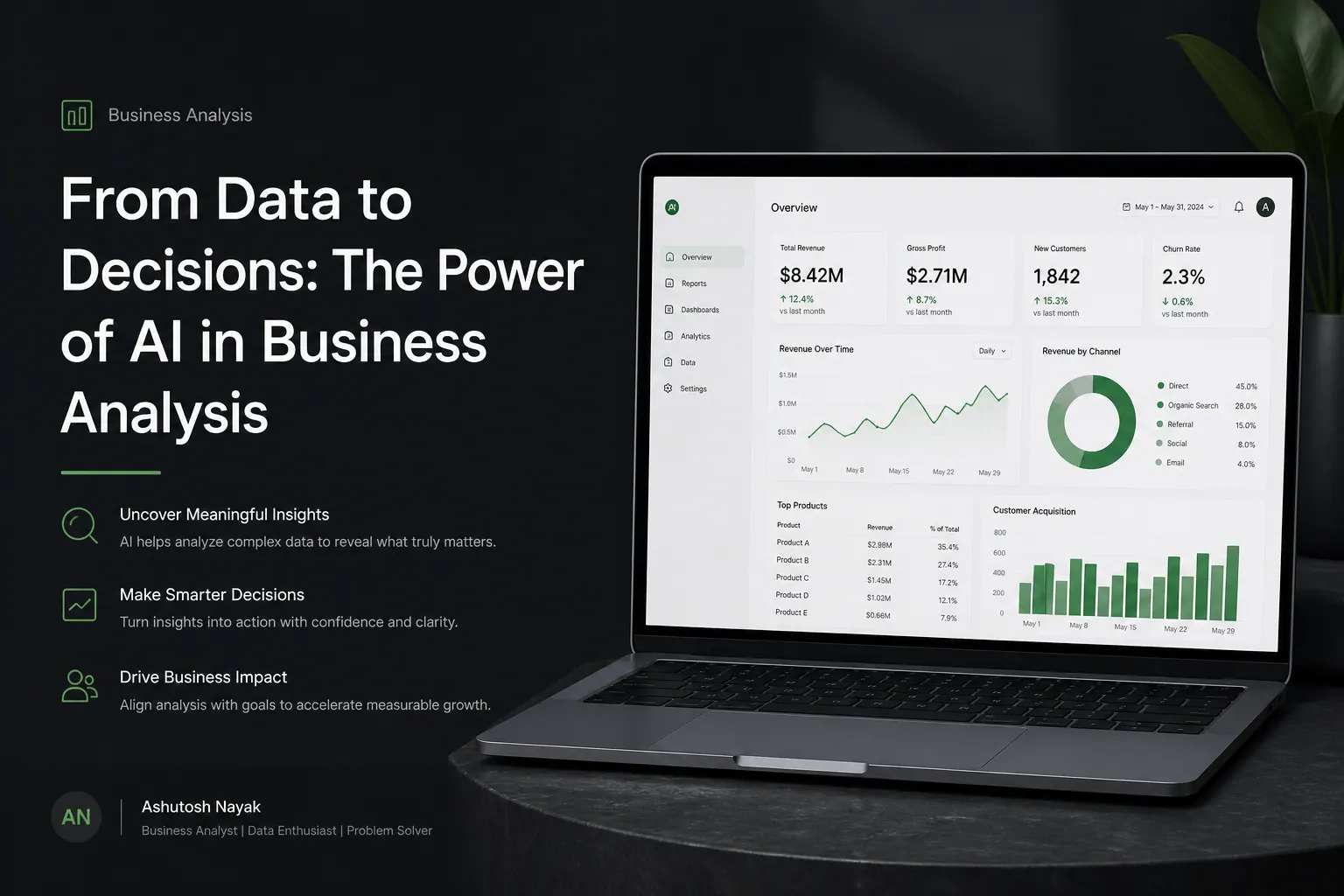
From Data to Decisions: The Power of AI in Business Analysis
Discover how AI transforms business analysis, enabling deeper insights and smarter decision-making. Learn practical applications and future trends.
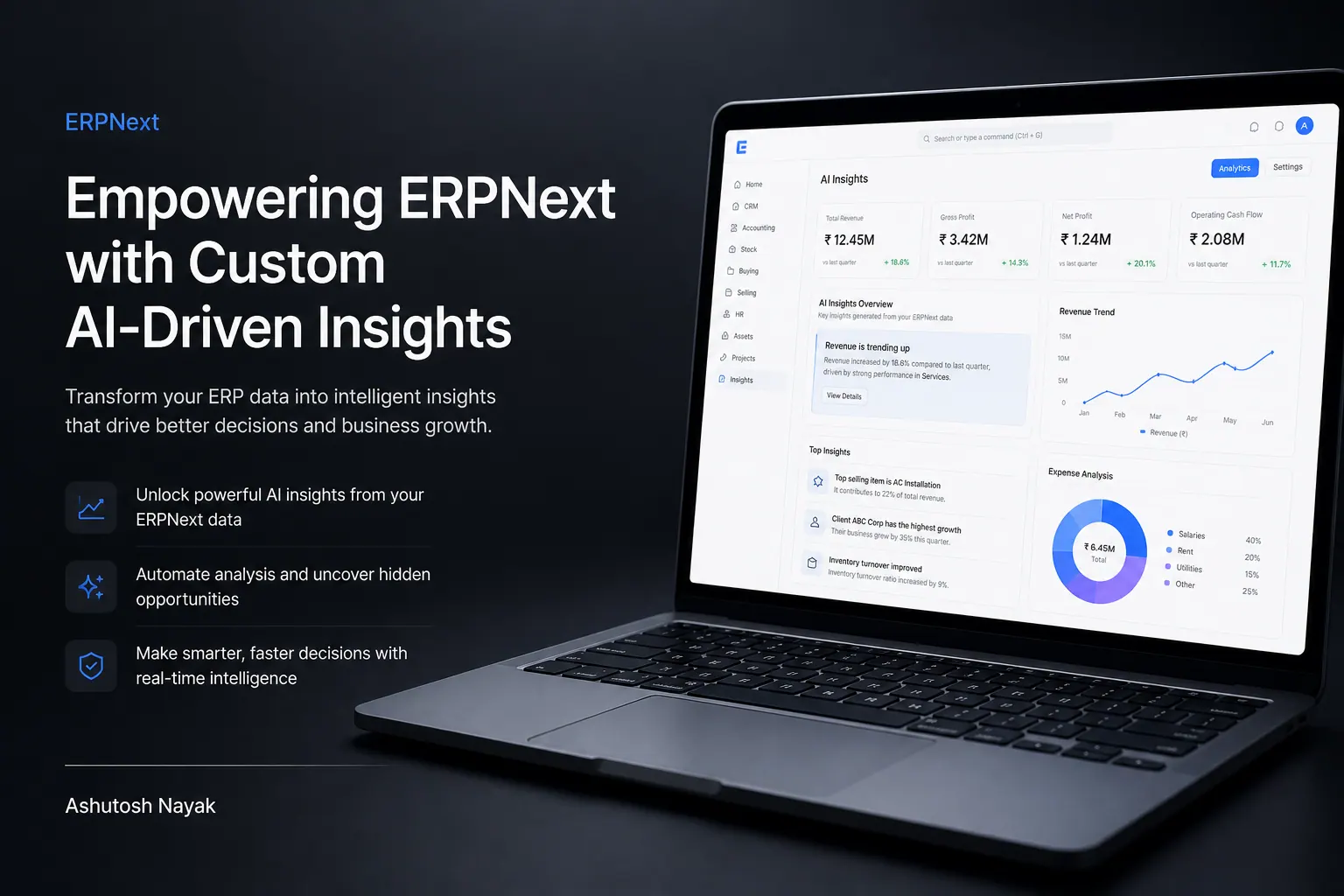
Empowering ERPNext with Custom AI-Driven Insights
Learn how to integrate custom AI models into ERPNext to unlock advanced business insights and automate complex decision-making processes.

Building Resilient Business Processes with Process Mining
Explore how process mining uncovers bottlenecks and inefficiencies in your ERPNext workflows, leading to optimized operations and data-driven improvements.
Get new articles in your inbox
Occasional writing on AI, ERP and data analytics — no spam, unsubscribe any time.