 Ashutosh Nayak
The Unsung Hero of Business Operations: Data Quality in ERPNext
In the fast-paced world of business, Enterprise Resource Planning (ERP) systems are the central nervous system, orchestrating everything from sales and inventory to finance and HR. Among the leading open-source ERP solutions, ERPNext, built on the Frappe framework, stands out for its flexibility and comprehensive feature set. However, the true power of any ERP system, including ERPNext, hinges on the quality of the data it holds. Poor data quality can lead to flawed insights, inefficient processes, incorrect financial reporting, and ultimately, bad business decisions. While ERPNext offers robust built-in validation rules, achieving truly pristine data quality requires a deeper, more strategic approach.
This post will delve into advanced techniques and best practices for mastering data quality within your ERPNext instance, going beyond the fundamental validation rules. We'll explore how to cultivate a data-aware culture, implement proactive data governance, leverage custom scripting, and utilize external tools to ensure your ERPNext data is accurate, consistent, and reliable.
Cultivating a Data-Aware Culture: The Human Element
Before diving into technical solutions, it's crucial to address the human element. Technology alone cannot solve data quality issues if the underlying organizational culture doesn't prioritize data accuracy. This involves:
- Training and Awareness: Regularly educate your users on the importance of accurate data entry. Explain why correct data matters – how it impacts reporting, decision-making, and the overall efficiency of the business. Use real-world examples from your own organization to illustrate the consequences of bad data.
- Clear Data Entry Guidelines: Document clear, concise, and easily accessible guidelines for data entry. These should cover standard naming conventions, required fields, acceptable formats, and common pitfalls. Make these guidelines readily available within the ERPNext interface or on a shared knowledge base.
- Ownership and Accountability: Assign clear ownership for data quality to specific roles or departments. When individuals or teams are accountable for the accuracy of the data they manage, they are more likely to pay attention to detail.
- Feedback Loops: Establish channels for users to report data inconsistencies or suggest improvements to data entry processes. Act on this feedback promptly to demonstrate that user input is valued and contributes to better data quality.
Proactive Data Governance: Setting the Stage for Quality
Data governance is the overarching strategy for managing data throughout its lifecycle. Implementing strong data governance principles within ERPNext can significantly enhance data quality:
- Data Dictionary and Glossaries: Create and maintain a data dictionary that defines all key data elements within your ERPNext instance. This includes field names, descriptions, data types, allowed values, and business context. A glossary of business terms ensures everyone speaks the same data language.
- Master Data Management (MDM): For critical entities like customers, suppliers, and products, implement a strategy for managing master data. This involves establishing a single source of truth for this data, ensuring consistency across different modules and avoiding duplication. ERPNext's
Customer,Supplier, andItemdoctypes are prime candidates for MDM. - Data Profiling: Regularly profile your data to understand its current state. Tools and scripts can help identify anomalies, inconsistencies, missing values, and outliers. This proactive analysis allows you to address issues before they escalate.
- Data Steward Roles: Appoint Data Stewards who are responsible for the quality of specific data domains. They can oversee data definitions, enforce policies, and resolve data quality issues within their purview.
Leveraging ERPNext's Capabilities: Beyond Basic Validation
While ERPNext's built-in validation rules are powerful, they are just the starting point. Here's how to go further:
Custom Validation Scripts
ERPNext's DocType allows you to define custom validation scripts using Python. These scripts can implement complex business logic that goes beyond simple field-level checks. For example:
- Cross-Field Validation: Ensure that if Field A is 'X', then Field B must be 'Y' or within a certain range. For instance, in a sales order, the
delivery_datecannot be earlier than theorder_dateplus a minimum lead time. - Inter-DocType Validation: Validate data based on information from another doctype. For example, when creating a
Purchase Order, check if theSupplierhas an outstandingCredit Limitthat would be exceeded by the order value. - Date and Time Logic: Implement sophisticated date and time validations, such as ensuring that a
leave_end_dateis always after theleave_start_date, considering holidays and working days.
To implement these, you would typically use the validate or on_validate method within your custom Python script associated with the relevant doctype.
Workflow and Approval Processes
Workflows in ERPNext can enforce data quality by requiring review and approval for critical transactions. For example:
- Sales Order Approval: High-value sales orders might require managerial approval, during which the data can be reviewed for accuracy.
- Purchase Order Approval: Similar to sales orders, purchase orders can be routed through an approval process to ensure accuracy in supplier selection, item details, and pricing.
- Journal Entry Verification: Financial transactions often require multiple levels of verification to prevent errors or fraud.
By structuring your business processes within ERPNext's workflow engine, you embed data quality checks directly into your operational flow.
Custom Reports and Dashboards for Data Monitoring
Regularly monitoring your data is essential. Use ERPNext's reporting tools and potentially custom scripts to create reports that highlight data quality issues:
- Duplicate Record Reports: Identify potential duplicate customers, suppliers, or leads.
- Incomplete Record Reports: Flag records missing critical information (e.g., missing contact details for a customer, missing tax ID for a supplier).
- Data Trend Analysis: Monitor key data points over time to detect unexpected shifts or anomalies that might indicate data quality problems.
Visualizing this data on dashboards provides a quick overview of the health of your data.
External Tools and Data Cleansing
Sometimes, existing data requires significant cleansing. For large datasets or complex cleansing tasks, external tools and techniques can be invaluable:
- Data Cleansing Tools: Utilize dedicated data cleansing software or libraries (e.g., Pandas in Python) to perform operations like deduplication, standardization, and error correction on data exported from ERPNext.
- Data Integration Platforms: If ERPNext integrates with other systems, ensure that data flowing between systems is validated and transformed correctly to maintain quality.
- Regular Audits: Conduct periodic data audits, either internally or with the help of external consultants, to identify systemic data quality issues and recommend remediation strategies.
The Ongoing Journey of Data Quality
Mastering data quality in ERPNext is not a one-time project but an ongoing commitment. It requires a combination of technological solutions, well-defined processes, and a culture that values accuracy. By implementing a multi-faceted approach that includes fostering a data-aware culture, establishing strong data governance, creatively utilizing ERPNext's customization capabilities, and employing external tools when necessary, you can transform your ERPNext instance from a data repository into a source of reliable intelligence. This, in turn, will empower your business with the accurate insights needed to make informed decisions, optimize operations, and drive sustainable growth. The investment in data quality is an investment in the future success of your business.
Related articles
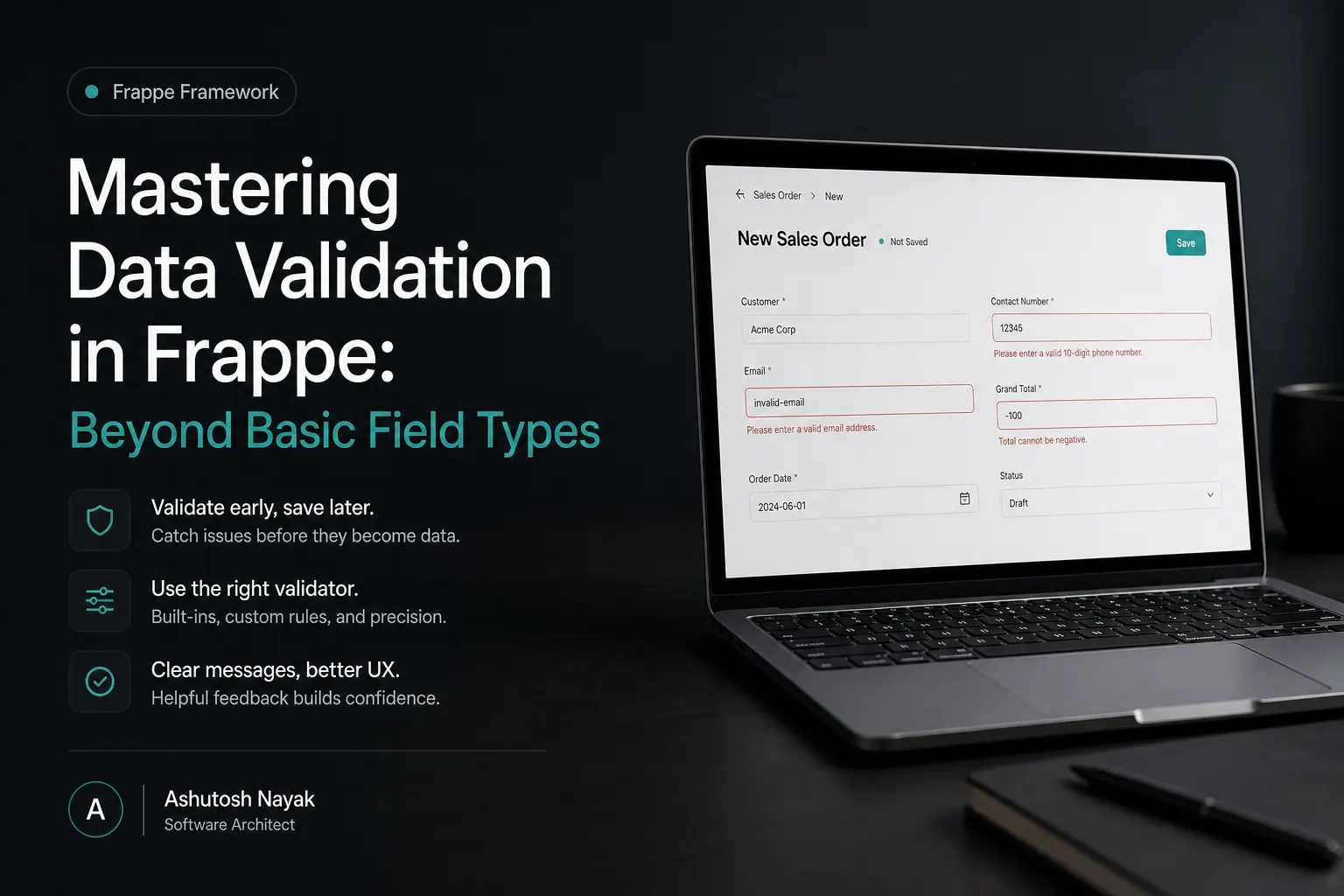
Mastering Data Validation in Frappe: Beyond Basic Field Types
Learn advanced data validation techniques in Frappe/ERPNext to ensure data integrity and build robust applications. Go beyond simple field types.

Customizing Frappe/ERPNext: Beyond Standard Features
Learn how to extend Frappe/ERPNext beyond its out-of-the-box capabilities using custom modules, scripts, and integrations for tailored business solutions.

Mastering Data Quality in ERPNext: Beyond Validation Rules
Unlock the full potential of your ERPNext data. Learn advanced techniques to ensure data quality beyond basic validation rules for better business insights.
Get new articles in your inbox
Occasional writing on AI, ERP and data analytics — no spam, unsubscribe any time.