 Ashutosh Nayak

The Challenge of Inventory Management in Growing Businesses
For any business, especially those utilizing an ERP system like ERPNext, efficient inventory management is paramount. Holding too much stock ties up valuable capital, incurs storage costs, and increases the risk of obsolescence. Conversely, insufficient inventory leads to stockouts, lost sales, delayed customer orders, and ultimately, damaged reputation. The traditional approach often relies on historical data and manual adjustments, which can be prone to human error and struggle to adapt to rapidly changing market dynamics, seasonal fluctuations, or unforeseen events.
ERPNext, with its robust features for inventory tracking, stock levels, and sales orders, provides a solid foundation. However, to truly gain a competitive edge, businesses need to move beyond reactive inventory management and embrace proactive, data-driven strategies. This is where the power of Machine Learning (ML) can be harnessed to transform ERPNext from a record-keeping system into an intelligent decision-making powerhouse.
Why Machine Learning for ERPNext Inventory?
Machine learning algorithms excel at identifying complex patterns and making predictions based on vast amounts of data. In the context of inventory management and demand forecasting, ML can analyze historical sales data, seasonality, promotional impacts, external economic indicators, and even weather patterns (for certain industries) to generate highly accurate forecasts. This accuracy translates directly into tangible business benefits:
- Reduced Holding Costs: By predicting demand more precisely, businesses can avoid overstocking, freeing up capital and reducing warehousing expenses.
- Minimized Stockouts: Accurate forecasting ensures that popular items are available when customers need them, preventing lost sales and improving customer satisfaction.
- Optimized Procurement: Understanding future demand allows for more strategic purchasing, potentially leading to better pricing from suppliers and more efficient supply chain operations.
- Improved Production Planning: For manufacturers, accurate demand forecasts are crucial for aligning production schedules with anticipated sales.
- Enhanced Financial Planning: More reliable sales forecasts lead to better revenue projections and more accurate budgeting.
Integrating ML Models with ERPNext
The integration of ML models into ERPNext can be approached in several ways, ranging from simple Python scripts to more sophisticated custom applications. The core idea is to feed relevant data from ERPNext into a trained ML model and then use the model's predictions to inform actions within ERPNext.
Data Extraction and Preparation
The first step is to extract the necessary data from ERPNext. Key data points typically include:
- Sales History: Item-wise sales volume over time.
- Item Master Data: Information about each product, including category, lead times, and current stock levels.
- Warehouse Information: Stock levels across different warehouses.
- Promotional Data: Records of past marketing campaigns and their impact on sales.
- Supplier Information: Lead times and reliability of suppliers.
This data can be extracted using ERPNext's API, direct database queries (SQL), or by generating reports. The data then needs to be cleaned, preprocessed, and feature-engineered. This might involve handling missing values, transforming date/time features, creating lag variables for time-series analysis, and encoding categorical features.
Choosing the Right ML Models
Several ML algorithms are suitable for demand forecasting and inventory optimization:
- Time Series Models: ARIMA, SARIMA, Exponential Smoothing (ETS) are classical statistical models that work well for data with clear trends and seasonality.
- Regression Models: Linear Regression, Ridge, Lasso, and ElasticNet can be used, especially when incorporating external factors.
- Tree-Based Models: Random Forests and Gradient Boosting Machines (like XGBoost, LightGBM) are powerful and often achieve high accuracy, handling non-linear relationships effectively.
- Deep Learning Models: Recurrent Neural Networks (RNNs), particularly Long Short-Term Memory (LSTM) networks, can capture complex temporal dependencies in long historical data.
The choice of model often depends on the complexity of the data, the volume of historical information, and the desired interpretability. It's often advisable to start with simpler models and progressively move to more complex ones if accuracy gains are significant.
Training and Evaluation
Once the data is prepared and a model is chosen, the next step is to train the model. This involves splitting the historical data into training and validation sets. The model learns patterns from the training set and its performance is evaluated on the validation set using metrics like Mean Absolute Error (MAE), Mean Squared Error (MSE), Root Mean Squared Error (RMSE), and Mean Absolute Percentage Error (MAPE).
Deployment and Integration
After training and evaluation, the trained model needs to be deployed. For ERPNext, this typically means making the model accessible via a Python script or a dedicated microservice. The integration can then occur in several ways:
-
Scheduled Scripts: A Python script can be scheduled to run periodically (e.g., daily or weekly). This script would:
- Fetch the latest data from ERPNext.
- Load the trained ML model.
- Generate demand forecasts for the next period (e.g., week, month).
- Compare forecasts with current stock levels.
- Potentially generate suggestions for Purchase Orders (POs) or Stock Entry documents within ERPNext.
-
Custom Frappe App: For a more seamless and integrated experience, a custom Frappe application can be developed. This app could:
- Include a dedicated UI for viewing forecasts and recommendations.
- Automate the data extraction and preprocessing steps.
- Trigger model predictions directly from the ERPNext interface.
- Allow users to approve suggested POs or stock transfers with a click.
- Provide dashboards visualizing forecast accuracy and inventory performance.
-
External Microservice: The ML model can be deployed as a standalone service (e.g., using Flask or FastAPI). ERPNext can then call this service via its API to get predictions, keeping the ML logic separate from the core ERP system.
Practical Considerations and Best Practices
- Start Small: Begin with forecasting for a subset of your most critical items before scaling to your entire inventory.
- Iterative Improvement: ML models are not static. Continuously monitor their performance and retrain them with new data as it becomes available.
- Domain Expertise is Key: Collaborate closely with your sales, procurement, and warehouse teams. Their insights are invaluable for feature engineering and interpreting model results.
- Data Quality Matters: The accuracy of your forecasts is highly dependent on the quality and completeness of your ERPNext data.
- Explainability: While complex models might offer higher accuracy, consider the need for explainability. Can you understand why the model is making a certain prediction? This is crucial for building trust and making informed decisions.
- Automation vs. Recommendation: Decide whether the ML system should fully automate actions (like creating POs) or provide recommendations for human review. For critical decisions, human oversight is often essential.
The Future: Proactive ERPNext
By integrating machine learning into your ERPNext instance for inventory management and demand forecasting, you transform your system from a passive data repository into an active, intelligent tool. This proactive approach allows businesses to anticipate future needs, optimize resource allocation, and significantly improve operational efficiency and profitability. As AI and ML technologies continue to advance, the potential for creating even more sophisticated and insightful ERP systems is immense. Embracing these technologies today is not just about staying competitive; it's about building a resilient and future-proof business.
Related articles

Enhancing ERPNext with Custom ML for Inventory Management
Leverage machine learning to optimize inventory levels in ERPNext. Reduce stockouts and overstocking for a more efficient supply chain.

Bridging the Gap: AI-Powered Business Analysis with ERPNext
Discover how AI can transform ERPNext data into actionable business intelligence, bridging the gap between raw data and strategic decisions.
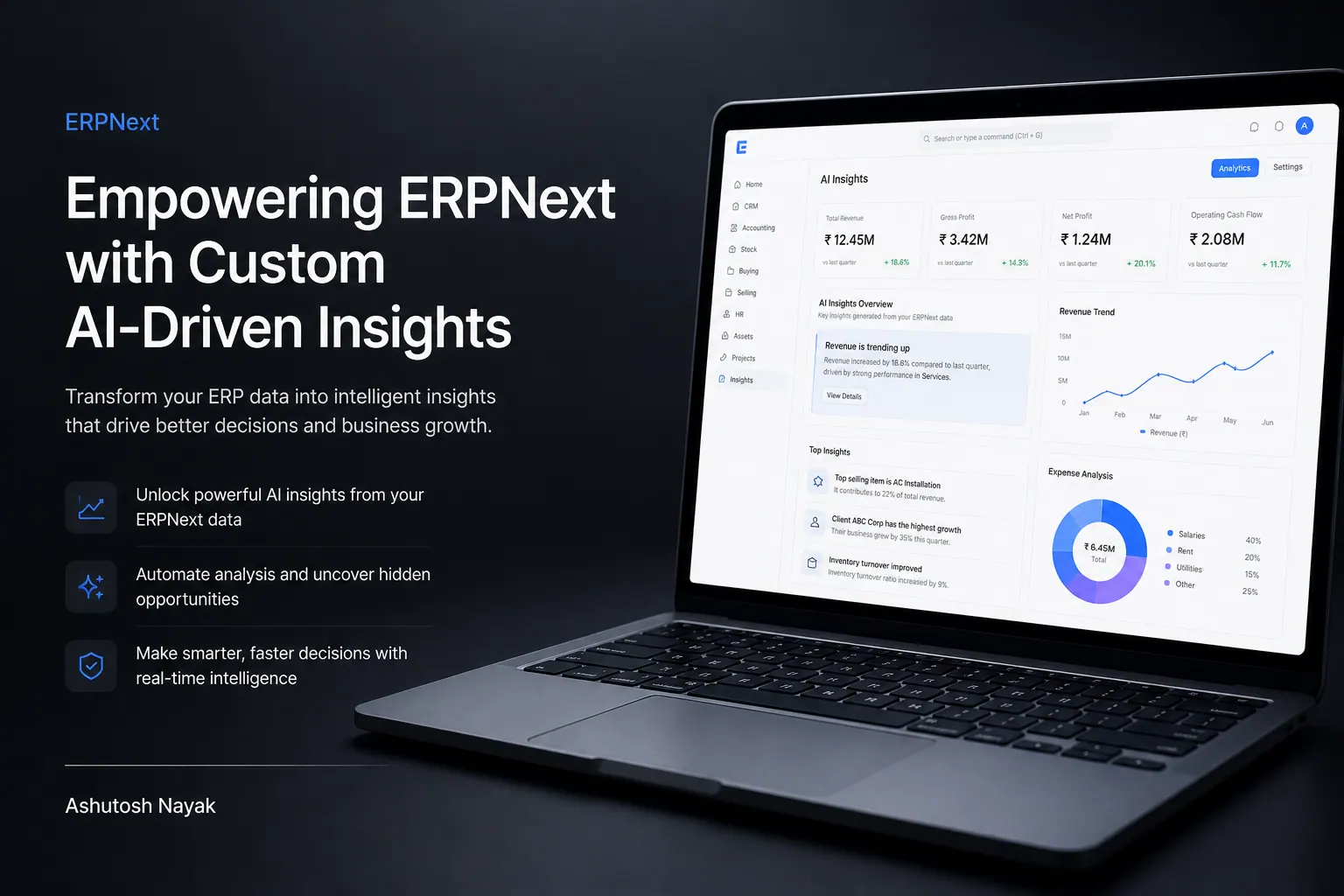
Empowering ERPNext with Custom AI-Driven Insights
Learn how to integrate custom AI models into ERPNext to unlock advanced business insights and automate complex decision-making processes.
Get new articles in your inbox
Occasional writing on AI, ERP and data analytics — no spam, unsubscribe any time.