 Ashutosh Nayak

The Traditional Business Analyst: A Foundation of Insight
For decades, the role of the business analyst has been crucial in bridging the gap between business needs and technological solutions. Armed with a toolkit of requirements gathering, process mapping, data analysis, and stakeholder management, business analysts have been the architects of understanding and change within organizations. They meticulously document current states, define future states, identify gaps, and translate complex business logic into actionable requirements for development teams. This often involves extensive interviews, workshops, surveys, and deep dives into existing data. The traditional analyst is a master of communication, a critical thinker, and a problem solver, essential for ensuring that technology truly serves business objectives.
However, the landscape is shifting. The sheer volume of data generated daily, the increasing complexity of business processes, and the demand for faster, more accurate insights are placing unprecedented pressure on traditional analytical methods. While the core skills of a business analyst remain invaluable, the tools and techniques available are rapidly evolving, driven by the advancements in Artificial Intelligence (AI) and Machine Learning (ML).
Enter the Augmented Analyst: AI as a Co-Pilot
The concept of the "augmented analyst" is not about replacing human analysts but about empowering them with AI-driven capabilities. Think of AI not as a substitute, but as a highly intelligent co-pilot, capable of handling tedious tasks, identifying patterns invisible to the human eye, and providing deeper, more predictive insights. This augmentation allows human analysts to focus on higher-level strategic thinking, complex problem-solving, and the nuanced human interactions that remain at the heart of successful business analysis.
Several key areas are seeing significant AI integration that directly benefits business analysts:
1. Enhanced Data Analysis and Pattern Recognition
Traditional data analysis, while powerful, can be time-consuming. AI and ML algorithms excel at processing vast datasets, identifying subtle correlations, anomalies, and trends that might be missed by manual review or standard statistical methods. AI-powered tools can automate tasks like data cleaning, feature engineering, and even initial hypothesis generation. For instance, an AI model can quickly sift through customer transaction data to identify unexpected purchasing patterns, segment customers more granularly based on behavior, or detect fraudulent activities with a higher degree of accuracy than rule-based systems.
This allows business analysts to spend less time wrestling with raw data and more time interpreting the why behind the patterns. They can ask more sophisticated questions, guided by AI-generated hypotheses, and focus on the strategic implications of the findings, rather than the mechanics of discovery.
2. Intelligent Process Mining and Optimization
Understanding and optimizing business processes is a core responsibility of business analysts. Process mining, traditionally a complex and often manual endeavor, is being revolutionized by AI. AI algorithms can automatically discover, monitor, and improve real processes by extracting knowledge from event logs readily available in information systems. This provides an objective, data-driven view of how processes actually run, revealing bottlenecks, deviations, and inefficiencies that might not be apparent through interviews or documentation alone.
An augmented analyst can leverage AI-powered process mining tools to not only visualize process flows but also to simulate the impact of changes, predict future performance, and identify root causes of process failures. This leads to more targeted and effective process improvements, directly impacting operational efficiency and customer satisfaction.
3. Automated Requirements Elicitation and Analysis
Gathering accurate and complete requirements is critical, yet often challenging. AI is beginning to assist in this area through natural language processing (NLP). AI tools can analyze existing documentation (like user manuals, customer feedback, past project requirements) to identify recurring themes, potential ambiguities, or even suggest missing requirements. They can also assist in analyzing customer feedback from various channels (surveys, social media, support tickets) to identify common pain points and feature requests.
While AI won't replace the need for direct stakeholder interaction, it can significantly streamline the initial phases of requirements gathering and validation. It can act as a pre-analyzer, highlighting key areas for the human analyst to investigate further, thus saving time and reducing the risk of overlooking critical information.
4. Predictive Modeling for Business Forecasting
Moving beyond descriptive analytics (what happened) and diagnostic analytics (why it happened), AI empowers business analysts with predictive analytics (what will happen) and even prescriptive analytics (what should we do about it). ML models can forecast sales, predict customer churn, estimate project completion times, and identify potential risks with much greater accuracy than traditional forecasting methods.
The augmented analyst uses these predictions not as definitive answers, but as powerful inputs into strategic decision-making. They can frame business cases around AI-driven forecasts, assess the confidence intervals of predictions, and develop mitigation or opportunity strategies based on AI insights.
5. Intelligent Documentation and Knowledge Management
Business analysts often deal with vast amounts of documentation. AI can help organize, summarize, and make this knowledge more accessible. AI-powered search functionalities can understand natural language queries, making it easier for analysts to find relevant information within large knowledge bases. AI can also assist in automatically generating summaries of lengthy documents or identifying key sections relevant to a specific analysis.
This improved access to information and distilled knowledge allows analysts to build upon existing work more effectively and avoid reinventing the wheel.
The Future is Collaborative: Human + AI
The integration of AI into business analysis is not a futuristic fantasy; it's a present reality that is rapidly evolving. The augmented analyst is emerging as the new standard, a professional who leverages AI tools to amplify their own expertise. This synergy allows for deeper insights, faster decision-making, and more robust solutions.
For aspiring and current business analysts, the key is to embrace these technological shifts. This doesn't mean becoming an AI expert overnight, but rather developing a foundational understanding of how AI can be applied within their domain. Learning to work with AI tools, understanding their outputs, and critically evaluating their limitations will be crucial skills. The focus will shift from solely data manipulation and documentation to strategic interpretation, complex problem-solving, and facilitating human collaboration, all supercharged by intelligent technology.
The augmented analyst will be the linchpin in organizations navigating the complexities of the modern business world, ensuring that technology serves humanity's goals with unprecedented insight and efficiency. The future of business analysis is not just about understanding the business; it's about understanding the business through the lens of intelligent augmentation.
Related articles

Bridging Business Gaps with LLMs: Beyond Code
Discover how Large Language Models can transform business analysis, streamlining workflows and uncovering insights beyond traditional methods.
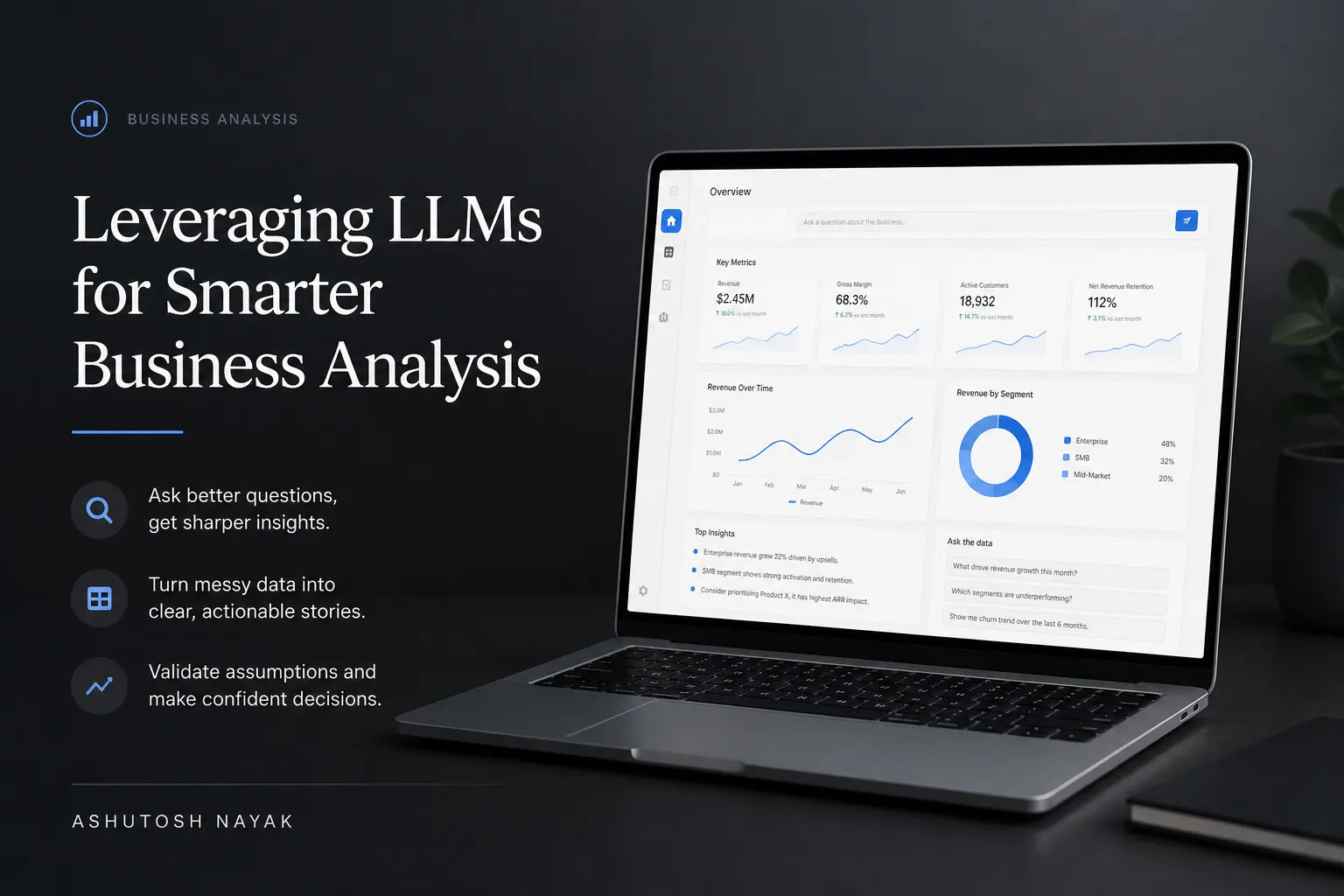
Leveraging LLMs for Smarter Business Analysis
Discover how Large Language Models (LLMs) can revolutionize your business analysis, from data interpretation to strategic decision-making. Explore practical applications and future potential.

Leveraging LLMs for Enhanced Business Process Discovery
Explore how Large Language Models (LLMs) can revolutionize business process discovery, moving beyond traditional methods to uncover hidden inefficiencies and opportunities.
Get new articles in your inbox
Occasional writing on AI, ERP and data analytics — no spam, unsubscribe any time.