 Ashutosh Nayak

The Power of General-Purpose LLMs
Large Language Models (LLMs) like GPT-4, Claude, and Llama have revolutionized natural language processing. Their ability to generate human-like text, answer complex questions, summarize information, and even write code is astounding. For many general business tasks – drafting emails, brainstorming ideas, or providing basic customer support – these pre-trained models offer a fantastic starting point. They have been trained on vast datasets, giving them a broad understanding of language, facts, and reasoning.
However, while these general-purpose LLMs are incredibly capable, they often fall short when it comes to highly specialized or domain-specific tasks. The language used in a legal contract differs significantly from that in a medical journal. The nuances of financial reporting are distinct from the jargon of manufacturing process documentation. A generic LLM might struggle to grasp these specific contexts, leading to inaccurate responses, irrelevant information, or a lack of the precise tone required.
This is where the concept of fine-tuning becomes indispensable. Fine-tuning is the process of taking a pre-trained LLM and further training it on a smaller, specific dataset relevant to your particular needs. Think of it as taking a brilliant, well-educated generalist and giving them specialized training in a niche field. The foundational knowledge remains, but the expertise is sharpened for a particular purpose.
Why Fine-Tune Your LLM?
There are several compelling reasons why fine-tuning an LLM can be a strategic advantage for businesses:
1. Domain Specificity and Accuracy
The most significant benefit of fine-tuning is improved accuracy within a specific domain. By training an LLM on your company's internal documents, industry-specific reports, or specialized knowledge bases, you enable it to understand and generate text with a much higher degree of relevance and precision. For instance, a legal firm could fine-tune an LLM on case law and legal statutes to assist in document review and drafting. A healthcare provider could fine-tune one on medical literature and patient records (anonymized, of course) for diagnostic assistance or medical summarization.
2. Enhanced Brand Voice and Tone
Every business has a unique brand voice and communication style. A generic LLM might produce responses that are polite but impersonal, or too formal, or too casual for your brand. Fine-tuning allows you to imbue the LLM with your specific tone, style, and vocabulary. This is crucial for customer-facing applications like chatbots, marketing content generation, or social media management, ensuring consistent brand representation.
3. Improved Efficiency and Reduced Hallucinations
When an LLM is fine-tuned on relevant data, it is less likely to 'hallucinate' or generate factually incorrect information. It has a more focused understanding of the domain, reducing the need for extensive fact-checking. This leads to more efficient workflows, as the AI can provide reliable outputs more consistently. For example, an ERPNext developer might fine-tune an LLM on Frappe framework documentation and common coding patterns to accelerate code generation and debugging for Frappe-based applications.
4. Cost-Effectiveness for Specific Tasks
While training an LLM from scratch is prohibitively expensive, fine-tuning a pre-trained model is significantly more cost-effective. You leverage the massive investment already made in training the base model and only incur costs for the additional training phase, which requires a smaller dataset and less computational power. For recurring, specific tasks, this can represent substantial savings compared to relying solely on general-purpose APIs or human labor.
5. Competitive Advantage
By tailoring AI capabilities to your unique business processes and knowledge, you create a competitive edge. Your internal tools can become smarter, your customer interactions more personalized, and your operational insights deeper. This specialized AI can automate complex internal workflows that general models would struggle with, freeing up human resources for higher-value strategic tasks.
The Fine-Tuning Process: A Practical Overview
Fine-tuning isn't a one-size-fits-all process, but it generally involves several key steps:
1. Defining Your Objective
Before you start, clearly define what you want the fine-tuned LLM to achieve. Are you looking to improve customer support response accuracy? Generate specific types of marketing copy? Summarize technical documentation? A clear objective will guide your data selection and evaluation metrics.
2. Data Collection and Preparation
This is arguably the most critical step. You need to gather a high-quality dataset that is representative of the task you want the LLM to perform. This data should be formatted correctly, often as pairs of prompts and desired responses (e.g., a customer query and the ideal answer). Data cleaning, deduplication, and anonymization (if sensitive information is involved) are essential. The size of the dataset can vary, but even a few thousand high-quality examples can yield significant improvements.
3. Choosing a Base Model
Select a pre-trained LLM that is suitable for your task and available for fine-tuning. Open-source models often provide more flexibility for fine-tuning. Consider the model's architecture, its performance on similar tasks, and the availability of fine-tuning tools and libraries.
4. The Fine-Tuning Training
Using frameworks like Hugging Face Transformers, TensorFlow, or PyTorch, you'll load the pre-trained model and train it on your prepared dataset. This involves adjusting the model's weights based on the new data. Techniques like LoRA (Low-Rank Adaptation) are popular for efficient fine-tuning, allowing you to adapt models with significantly fewer trainable parameters, thus reducing computational cost and memory requirements.
5. Evaluation and Iteration
After fine-tuning, it's crucial to evaluate the model's performance against your defined objectives. Use a separate test dataset to measure accuracy, relevance, and adherence to brand guidelines. Based on the evaluation, you may need to iterate: adjust hyperparameters, collect more data, or refine the data preparation process. This iterative approach is key to achieving optimal results.
Considerations and Challenges
While fine-tuning offers immense benefits, it's not without its challenges:
- Data Quality: The adage 'garbage in, garbage out' is particularly true for fine-tuning. Poor quality or biased data will result in a poorly performing or biased model.
- Computational Resources: While less demanding than pre-training, fine-tuning still requires adequate computational resources (GPUs) and technical expertise.
- Overfitting: It's possible for the model to become too specialized, performing exceptionally well on the fine-tuning data but poorly on slightly different, real-world inputs. Careful validation is needed to prevent this.
- Cost Management: While more cost-effective than training from scratch, fine-tuning still incurs costs for data preparation, compute time, and expertise.
Conclusion
In the rapidly evolving landscape of AI, general-purpose LLMs are powerful tools. However, for businesses seeking to leverage AI for specific, high-impact applications, fine-tuning is the pathway to unlocking true potential. By tailoring these advanced models to your unique data, domain, and brand, you can achieve unparalleled accuracy, consistency, and efficiency. As an AI & ML Engineer and Frappe/ERPNext Developer, understanding and implementing fine-tuning strategies can lead to the creation of bespoke AI solutions that drive tangible business value, making your AI investments more strategic and effective.
Related articles
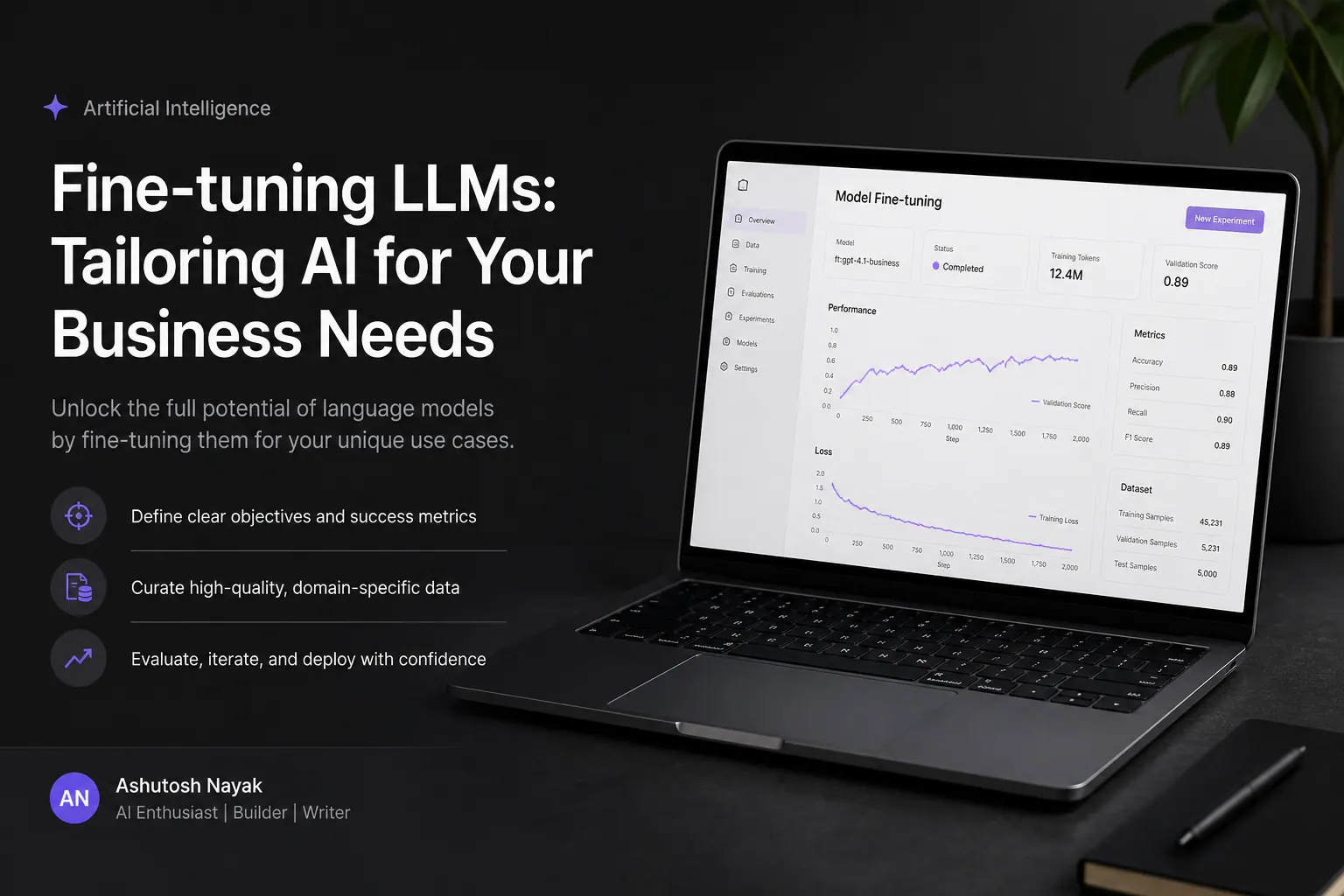
Fine-tuning LLMs: Tailoring AI for Your Business Needs
Learn how fine-tuning large language models (LLMs) can customize AI for specific business tasks, improving accuracy and relevance. A practical guide.

Mastering LLM Prompts: A Practical Guide for Developers
Unlock the full potential of Large Language Models. Learn practical prompt engineering techniques to build more effective AI applications.

Fine-tuning LLMs: A Practical Guide for Developers
Learn the essentials of fine-tuning Large Language Models (LLMs) for custom applications. A practical guide for developers.
Get new articles in your inbox
Occasional writing on AI, ERP and data analytics — no spam, unsubscribe any time.